


Family Law Evolved: Takeaways from an IAALS Convening

At a regular conference, people are always extremely busy and focused on presenting their papers, leaving only a few minutes to discuss with peers. There is never enough time to go in-depth on any topic. At IAALS’ Family Law Evolved: A Non-Adversarial Model for Modern Families convening last month, that was not the case. We were given time to really collaborate and explore how to reimagine the family justice system. This is a complex and difficult question that requires focus to design a new process from the ground up. IAALS gave us the time we needed to do that and showed each of us there is a role we can all play to make that change a reality.
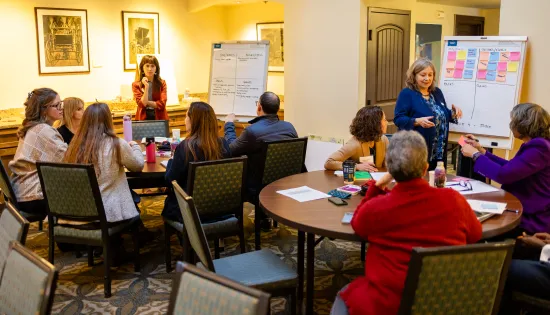
We analyzed the current family justice system and asked ourselves, “what could it be?” Collaborating with family law experts across the field was essential to understanding how we can align our individual efforts for collective change. Across the four groups tasked with mapping out what a new family law system could be, the results were closely interlinked.

I felt able to share my own experience of traversing new ways to look at family law in Australia and how this can shape the agenda in the United States. My work in developing the digital tool amica with the Australian government to help couples separate showcases how technology can support an improved system. Every year amica supports thousands of people, many self-represented, as they navigate the family law process. We are now working across Massachusetts, Alaska, and Los Angeles to apply these learnings in the U.S. The outcomes from the convening will help shape our focus and roadmap to achieve this.
These conversations are vital, and we all struggle to find the time in our day-to-day to have these discussions. What excites me is we’re all aligned on where the change could be—a more family-centered system, clearer diversion pathways, better uses of technology. As we build stronger bonds between us, we increase the chances of making a change to a non-adversarial approach.
I left the convening motivated to keep going. Many of us do this work in isolation. The way IAALS curated the agenda and attendees at the convening has done so much to increase the possibility of a better family justice system. I have always been impressed with the role IAALS plays in gathering experts and leaders in the justice system in the U.S. There is no manual on how to improve the justice system, but IAALS is helping us write one.
