News & Updates

List of news articles

Showing 81 - 100 out of 404 results for Judicial selection

  • New Mexico's Hybrid Judicial Selection Process Comes Under Scrutiny

    New Mexico judges are chosen through a process that is truly unique. Since 1988, judicial vacancies have been filled by commission-based appointment. Appointees then face a partisan election to keep their seats. At the conclusion of their terms, judges stand for retention for subsequent terms. This year, five judges waited until after the filing deadline to announce their retirement, exemplifying what some see as an increasing trend by judges and party leaders to try to influence judicial selections.

  • Expert Opinion

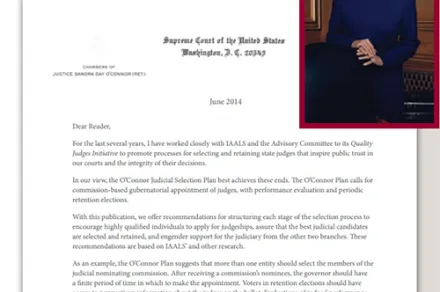
    Toward Impartial and Accountable Judges

    In recent years, I have been distressed to see persistent efforts in some states to politicize the bench and the role of our judges. Working closely with IAALS and its Quality Judges Initiative, we have collaborated to promote processes for selecting and retaining state judges that inspire public trust in our courts and the integrity of their decisions. Today, I am pleased to share with you the O’Connor Judicial Selection Plan—our recommendations for protecting and strengthening the courts.

    1
  • Russell Wheeler Makes a Case for Caution on Federal Judicial Confirmations

    Recent national media coverage paints a highly positive picture of the current pace of federal judicial nominations and confirmations. After all, 2014 has seen 50 confirmations so far, compared to 43 in all of 2013 and 48 in 2012. Not so fast, says Russell Wheeler, an IAALS Board Member and Visiting Fellow at the Brookings Institution. The outlook has improved, but according to Wheeler, a case can be made for a more cautious assessment.

  • Voter Education Effort Featuring Justice O'Connor Wins Emmy Award

    Developed as part of the “Informed Voters – Fair Judges” project, a voter education effort led by the National Association of Women Judges, a short film featuring retired U.S. Supreme Court Justice Sandra Day O'Connor has received an Emmy Award in the Public Service Announcement category from the National Capital Chesapeake Bay Chapter of the National Academy of Television Arts and Sciences.

  • Federal Judge Okays Ohio's Unusual System for Electing Judges

    A federal judge has upheld the unusual system that Ohio uses to elect its judges, which features partisan primary elections and a nonpartisan general election. The challenge to the Ohio system was first filed in 2010 by the Ohio Democratic Party, three judicial candidates, and a public employees union, who claimed that not allowing judicial candidates to run with party labels violated their First Amendment rights.

  • In a Deal with Democrats, Governor Christie Re-Nominates State's Chief Justice

    Ending months of speculation, Governor Chris Christie re-nominated Chief Justice Stuart Rabner to the New Jersey Supreme Court. The move was part of a political compromise with senate leadership, which agreed in exchange to support the nomination of a Christie ally to the supreme court. The deal between Governor Christie, a Republican, and Democrats in the senate will fill one of two seats on a court that has had two vacancies since early 2012.

  • Tennessee Justices Launch Retention Campaign with Bar Support

    As the burgeoning campaign in opposition to the retention of the three Tennessee justices continues, those justices are responding with their own campaign. They recently gave an interview to a local news outlet in which they discussed the threat that the retention challenge poses to judicial independence. The Tennessee and Nashville bar associations have both entered the fray as well.

  • North Carolina's 2014 Supreme Court Election Is One to Watch

    Four of the seven seats on the North Carolina Supreme Court are on the ballot in November. The current ideological balance on the court is 4-3, with a Republican majority, and three of the four seats up for election are currently held by Democrats. Commentators anticipate millions of dollars in special interest spending in the coming months.

  • March Legislative Roundup: Judicial Selection and Tenure

    With state legislatures in session around the country and considering bills that would impact the selection and tenure of state judges, IAALS Online provides this summary of where things stand at the end of March. Developments in: Alaska, Florida, Hawaii, Minnesota, Oklahoma, Tennessee, Utah, and Washington.


  • Florida Legislators Propose What Some Label Another Court-Packing Plan

    The terms of three members of Florida's seven-member supreme court are set to expire at the same time that the next Florida governor's term expires—on January 8, 2019. Recognizing that state law is unclear as to whether the outgoing or incoming governor has the authority to fill judicial vacancies that occur on inauguration day, a Republican senator has offered a proposed constitutional amendment that would empower the outgoing governor to make these appointments.

  • Alaska Legislators Seek to Change the Way Judges Are Selected

    Republican state legislators have proposed a bill that would increase the size of, and allow the governor to appoint a majority of members to, the Alaska Judicial Council. The AJC serves as both the judicial nominating commission and the judicial performance evaluation commission. Under the new bill, the AJC would be expanded to 16 members, and the change would require amending the constitution.

  • Selection Reform Proposals Trend toward Enhancing Gubernatorial Authority

    There are several anticipated efforts in 2014 to alter processes for selecting state court judges, particularly in states with commission-based gubernatorial appointment of appellate judges. In Kansas, Oklahoma, and Tennessee, as in Arizona and Florida in recent years, legislative proposals are aimed at directly or indirectly expanding the governor's appointing authority.

  • Selection Reform on the Agenda in Several States in 2014

    With the start of a new year comes the convening of state legislatures around the country, and, in a number of states, judicial selection reform is on the table. Kansas, Missouri, Oklahoma, Tennessee, Texas, Minnesota, and Pennsylvania will all consider changes in how their judges reach the bench.