News & Updates

List of news articles

Showing 201 - 220 out of 488 results for Civil justice reform

  • Illinois Judicial College Draws Hundreds of Judges, Calls to Action

    Illinois takes judicial education seriously. In 2015, the state Supreme Court formed the Illinois Judicial College, and very recently I was honored to participate in its first full-week debut of courses. Over 400 judges participated and there were over 100 course offerings for them. At the initial plenary session, there was energy in the room—colleagues enjoying being together, eager to learn new things and share information.

    1
  • IAALS Partner Christine Whitman to Lead Democracy Task Force

    In response to the “enormous pressure” and polarization weighing on the American political landscape, the Brennan Center for Justice has launched the National Task Force on the Rule of Law and Democracy. One of the co-chairs of the Task Force is IAALS O’Connor Advisory Committee Member and former Governor of New Jersey Christine Todd Whitman. She is joined in leadership by co-chair and former U.S. Attorney Preet Bharara.

    1
  • IAALS Advances Justice with Mary McQueen

    Mary McQueen is a leader and a visionary. Mary and I first met many, many years ago—when she was the State Court Administrator in Washington and I was on the Colorado Supreme Court. By the time I started IAALS, she had become the President of the National Center for State Courts. She was one of the first people I reached out to, because I saw so many natural partnerships that we could forge between IAALS and the National Center—and indeed we have.

  • Guest Blog

    Workshops Bring Oxygen and Sunshine to Civil Justice Reforms

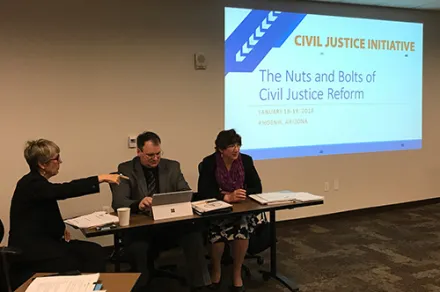
    IAALS, in partnership with the National Center for State Courts (NCSC), continued its leadership on implementing Civil Justice Initiative reforms at a workshop held in Phoenix, Arizona, January 18-19. The program, The Nuts and Bolts of Civil Justice Reform, was co-sponsored by the NCSC and the Maricopa County Superior Court. Approximately 20 judges and court administrators participated, from Hawaii to Tennessee.

    1
  • New FLSA Protocols Encourage Cooperation and Faster Resolution

    ​Bloomberg BNA recently highlighted IAALS’ Fair Labor Standards Act (FLSA) Protocols, which aim to simplify discovery procedures for FLSA cases. Released last month, the protocols call for a specific set of documents to be released by each party at the start of the case in an effort to streamline discovery and lead to a quicker resolution of the case.

    1
  • Judges and Past Jurors Come Together to Improve Jury Trials

    How can jury trials be better? That was the question being discussed at the Jury Improvement Lunch recently held in Denver by the New York University School of Law's Civil Jury Project. The luncheon was sponsored by a number of local bar organizations, including IAALS, and hosted by a number of local law firms. Headed by attorney Stephen Susman, the Civil Jury Project is holding similar events across the country at which judges and recent jurors are brought together to share progressive trial practices with the local bench and bar.

    1
  • Upcoming Workshop on the Nuts and Bolts of Civil Justice Reform

    On January 18-19, 2018, in Phoenix, Arizona, the National Center for State Courts and the Maricopa County Superior Court will host a Civil Justice Initiative Implementation Workshop on the Nuts and Bolts of Civil Justice Reform. This workshop is part of the three-year implementation effort that follows the Conference of Chief Justices (CCJ) and Conference of State Court Administrators (COSCA) endorsement of 13 recommendations designed to transform the civil justice system in our state courts.

    1
  • Convening Highlights the Role of Judges and Lawyers in Improving Motions Practice

    While a significant focus of civil justice reform has been on the cost and delay of discovery, IAALS has heard the call for reform in the area of motions practice as well, which can similarly result in great cost and delay to the parties. In response, IAALS hosted a convening earlier this month at the Penrose House in Colorado Springs, Colorado, devoted to addressing the current challenges in dispositive motions practice.

    1
  • Colorado Judges Teach Civics to the Public

    In a society where only 26 percent of adults can name all three branches of the federal government and a third cannot even name one, Colorado's judicial branch has sought to improve its citizens’ civics knowledge through Our Courts Colorado. The nonpartisan program provides civics education presentations in both English and Spanish for adults in their communities across the state, many given by state and federal judges.

    1
  • Unbundle Now: Taking Limited Scope Representation Mainstream

    For young legal practitioners, integrating limited scope representation into law school curriculums is a giant step toward increasing awareness and mastery of modern legal practice. This was the position of the “Unbundling for the Next Generation” panel at the IAALS/ABA Better Access through Unbundling conference on the University of Denver campus last month. Professors Andrew Schepard, Danielle Hirsch and Luz Herrerra presented on the benefits of integrating limited scope representation into clinics and experiential classes, law school incubators, and bar events that target young lawyers, as well as educating court staff to promote referral panels.

    1
  • Denver to Host Jury Improvement Luncheon

    The Civil Jury Project at NYU School of Law, whose Executive Director is Steve Susman, is organizing a Jury Improvement Lunch for the Colorado bench and bar this Thursday, November 2. The goal of the lunch is to honor jurors who have recently served by inviting them to attend a lunch with judges and lawyers in the community to share their experiences and to learn from them about what can be done to improve civil trials. These education programs, dubbed “Jury Improvement Lunches,” began in Texas and have been held in Houston, Dallas, and Corpus Christi. In addition to Denver, the project is now organizing similar lunches in Boston, Baltimore, San Francisco, Kansas City, Seattle, Oklahoma City, and Cleveland.

    1
  • Commission on Future of California Court System Recommends Innovations

    Over the last three years, California has undertaken an effort to “research and analyze innovative proposals for the justice system of the future.” The work has culminated in a final report that was submitted to the Chief Justice on April 26, 2017. The report from the Commission on the Future of California’s Court System focuses on practical ways to more effectively adjudicate cases, achieve greater fiscal stability, and use technology to enhance the public’s access to the courts. The breadth of the report is tremendous, making sweeping recommendations in criminal law, civil law, family law, court administration, and technology.

    1
  • Expert Opinion

    Lawyers and Technology: A Combination to Improve Access to Justice

    Technology has radically altered how legal help is sought—and how it is delivered—yet there is still an overwhelming need for affordable and accessible legal services in the United States. This gulf can only be bridged when attorneys adopt new ways of approaching the practice of law and the delivery of legal services.

    1
  • Arizona Supreme Court Approves Civil Justice Reforms

    Arizona’s Supreme Court has approved numerous civil justice reforms “aimed at reducing the time and expense it takes to resolve civil cases in Arizona’s superior courts.” The reforms are based on the recommendations of Arizona’s Civil Justice Reform Committee, which was established by the Arizona Supreme Court in December 2015 to “develop recommendations, including rule amendments or pilot projects, to reduce the cost and time required to resolve civil cases in Arizona’s superior courts.”

    1
  • Judge Posner, Self-Represented Litigants, and Changing Our Legal System

    By now, the word is out that Judge Richard A. Posner is retiring from the 7th Circuit Court of Appeals. His retirement was unexpected, but his stated reasons for doing so shouldn’t be. In correspondence announcing his departure, Judge Posner sites apparent “difficulty” with his colleagues on the bench over the treatment of self-represented litigants as the motivation to leave the bench. A prompt response from Chief Judge Diane P. Wood, also on the 7th Circuit Court of Appeals, countered Judge Posner’s claim by stating, in part, “the judges and our staff attorneys take great care with pro se filings.” Judge Posner’s point, though, is more indicative of the entire justice system than a particular court and its staff attorneys.

  • States Get New Tools to Help the Civil Justice System Reform Process

    Across the nation, states are reforming the civil justice system. They are taking action in response to the Conference of Chief Justices' (CCJ) and Conference of State Court Administrators' (COSCA) endorsement of 13 recommendations focused on ensuring our courts are affordable, efficient, and fair for all. States are creating civil justice reform task forces and committees focused on improving the delivery of civil justice in their own states. To aid that process, IAALS and the National Center for State Courts (NCSC) have rolled out several new tools as part of a three-year Implementation Plan to provide states with education and technical assistance. This month we released two new tools.

    1
  • Strong Support for Civil Justice Reform

    A recent study conducted for Voices for Civil Justice, with support from the Public Welfare Foundation, found that voters strongly favor reform of the civil justice system. Overwhelming majorities of voters believe it is important to “ensure that everyone has access to the civil justice system” and “strongly support a wide range of services to enhance access.” Moreover, voters support increasing state funding to build a more accessible civil justice system. The survey highlights that equal justice under the law in our society is fundamental, with voters considering it a right, not a privilege.

    1
  • ABA Adopts Resolution Supporting Trial Experience for Young Lawyers

    At its annual meeting this week in New York City, the ABA House of Delegates adopted Resolution 116 urging courts to implement plans that provide meaningful courtroom experience to new lawyers. The resolution—recognizing the important role law firms and clients play in the experience, or lackthereof, that young lawyers receive—also urges law firms and clients to take advantage of those plans.