News & Updates

List of news articles

Showing 121 - 140 out of 310 results for Family justice reform

  • Annual Report

    Action to Justice: IAALS 2017 Annual Report

    We are proud to present you with IAALS' 2017 Annual Report, showcasing our efforts to help create a legal system that works for everyone. The theme this year is “Action to Justice.” Throughout the report, you will see images that are straight out of the comics. But despite the whimsical tone, the real message is that we live in times that pose great challenges to our system of justice, and superheroes must answer the call to act.

    1
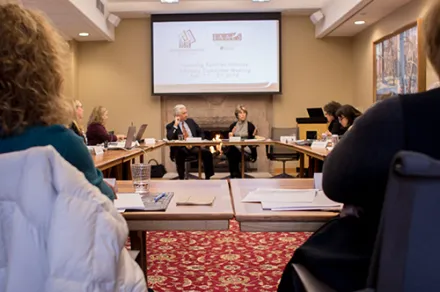
  • Honoring Families Initiative Advisory Committee Meets to Chart Path for Work

    The Advisory Committee of the Honoring Families Initiative here at IAALS met last month. The Committee, chaired by Bill Howe, a domestic relations practitioner from Oregon, is a group of multi-disciplinary, extremely experienced and skilled people—who care a great deal about families in the courts. They have been with IAALS since the onset of the HFI work, and they continue to be our secret weapon.

  • New Tax Law Could Encourage More Divorces in 2018

    ​Some experts are predicting that a change in alimony rules under the new tax law passed late last year may increase the number of divorces this year. The new tax law changes the alimony deduction, which has been in place since 1942. Beginning in 2019, spouses who pay alimony won’t be permitted to take any deductions, and spouses receiving alimony won’t be required to report those payments as income.

    1
  • Online Domestic Abuse Self-Help Tool Joins Technology-Based Trend

    FreeFrom, a Los Angeles-based nonprofit, is releasing a self-help tool aimed at helping survivors of domestic abuse get the resources and information they need to pursue financial compensation. Many victims of domestic abuse never seek legal relief, simply because they don’t know what options they have or how to pursue them.

    1
  • IAALS Launches Family Justice Initiative with NCSC and NCJFCJ

    In August 2016, the Conference of Chief Justices’ Civil Justice Improvements Committee released—and the Conference adopted—Call to Action: Achieving Civil Justice for All, outlining a comprehensive set of recommendations for civil justice reform. The Committee charge was limited to civil cases, and the National Center for State Courts recently launched a corollary project to explore domestic relations cases. The Family Justice Initiative is a partnership between IAALS, the Conference of Chief Justices, the Conference of State Court Administrators, and the National Council of Juvenile and Family Court Judges—with support from the State Justice Institute.

    1
  • Expert Opinion

    Lawyers and Technology: A Combination to Improve Access to Justice

    Technology has radically altered how legal help is sought—and how it is delivered—yet there is still an overwhelming need for affordable and accessible legal services in the United States. This gulf can only be bridged when attorneys adopt new ways of approaching the practice of law and the delivery of legal services.

    1
  • Judge Posner, Self-Represented Litigants, and Changing Our Legal System

    By now, the word is out that Judge Richard A. Posner is retiring from the 7th Circuit Court of Appeals. His retirement was unexpected, but his stated reasons for doing so shouldn’t be. In correspondence announcing his departure, Judge Posner sites apparent “difficulty” with his colleagues on the bench over the treatment of self-represented litigants as the motivation to leave the bench. A prompt response from Chief Judge Diane P. Wood, also on the 7th Circuit Court of Appeals, countered Judge Posner’s claim by stating, in part, “the judges and our staff attorneys take great care with pro se filings.” Judge Posner’s point, though, is more indicative of the entire justice system than a particular court and its staff attorneys.

  • IAALS Advances Justice with Family Law Attorney Bill Howe

    Bill has been involved with IAALS since 2012, when we launched the Honoring Families Initiative Advisory Committee on which he serves. We have worked together on our original vision-paper, on the Center for Out-of-Court Divorce, the Family Bar Summit, The Modern Family Court Judge, and now our online dispute resolution project called Court Compass. At every turn, every phone call, every email, Bill has been a generous, responsive, and wise partner.


  • Better Access through Unbundling: IAALS and ABA Host Conference on Implementation

    The legal industry is changing. In some courts, upwards of 80% of civil and family cases involve litigants who are navigating the court system without any form of legal assistance. Research has confirmed that the primary reason so many do not have the benefit of a lawyer is because of cost. The inability to afford an attorney is no longer an issue confined to low-income Americans. Increasingly, middle-class litigants are finding themselves priced out of legal services as well. In addition, even litigants who can afford an attorney may choose to opt for self-representation in order to maintain a certain level of control over their legal matters or to keep the costs of such services down.

    1
  • Divorce Out of Court: Exchanging Ideas for the Future

    Too often, an adversarial family court process does not provide the best outcomes for families going through divorce or separation. Yet, most people are still primarily directed to the courts for resolution of these family law issues—and most courts hearing these matters have overburdened dockets and lack the resources most likely to improve outcomes for parents and their children. Families in these situations can benefit tremendously from services that help them plan for the future in ways that maximize their joint interests and minimize any negative effects or outcomes for their children. The Center for Out-of-Court Divorce (COCD) in Denver, Colorado, offers proven processes for separating and divorcing families that enable better outcomes for children and that provide greater accessibility, efficiency, and fairness for all parties.

    1
  • Expert Opinion

    Australia Could Teach America a Thing or Two about Legal Reform

    I spent two weeks in Australia in May, meeting Australian judges, lawyers, law professors, deans, and legal service providers. I spoke at a conference dedicated to examining the role of empirical data in legal system reform, visited two Family Relationship Centres, and horrified a group of Australian judges by detailing how judges are elected in partisan elections in some states in the United States. The whole experience confirmed my notion that Australia is leading the way in legal system reform.

    1
  • IAALS is Growing with Addition of Three New Staff Members

    IAALS is expanding: both in terms of our capacity for impact and in the literal expansion of our ranks. Specifically, we are delighted to announce that Managers Nathaniel Baca and Zack DeMeola and Research Assistant James Swearingen joined our organization in June. Already, they are broadening and deepening our work.

    1
  • Wisconsin Supreme Court Supports Enhanced Role for Lawyer Mediators

    The Wisconsin Supreme Court recently approved a rule allowing a lawyer-mediator to draft and file settlement documents in family law cases, which can provide a more cost-effective path to divorce for families. In this situation, the lawyer’s role is limited and the he or she would not represent either party to the mediation; therefore, the lawyer may not give legal advice or advocate on behalf of either party. Parties are also encouraged to seek independent legal advice prior to signing the documents prepared by the lawyer-mediator.

    1
  • Washington LLLT Program Rates Well, Inspires Other States to Action

    Washington State’s innovative Limited License Legal Technicians (LLLT) program was recently evaluated by the National Center for State Courts and found to be a well-designed program for expanding legal assistance. LLLTs are non-lawyers who are specially trained to provide certain kinds of legal assistance. And, unlike paralegals, LLLTs practice without having to be supervised by a lawyer. Becoming a LLLT requires an associate-level degree of at least 45 credits and an additional 15 credits in family law from an ABA-approved law school. In Washington, the training is provided by the University of Washington School of Law, with Gonzaga University School of Law professors helping to teach the courses.

    1
  • Expert Opinion

    The Legal Marketplace is Changing and Innovating

    Consumer demand and innovations in the legal marketplace, especially technological advances, are leading the charge for changes in the legal profession. Many legal educators, lawyers, court administrators, and judges are embracing the evolution, but others are still reluctant to disrupt the status quo.

    1
  • Access to Legal Services for Low Income People on President’s List of Cuts

    On the front of the United States Supreme Court building in Washington, D.C., is the proclamation “Equal Justice Under Law.” However, according to our Cases Without Counsel study, in some jurisdictions nearly 80 percent of people with a court case end up representing themselves. For many, not being able to afford a lawyer is the main reason for the wide justice gap.

  • Annual Report

    The Stage is Set: IAALS 2016 Annual Report

    I am so proud to present to you our 2016 Annual Report, capturing a remarkable year in our existence and representing the work of our truly visionary staff. Last year we celebrated our tenth-year anniversary. As we embark upon the next ten, in this report we embrace the theme: The Stage is Set: Lights, Camera, Innovation. Throughout the report, you will find not only evidence of what we have accomplished, but also the ways in which we are setting the stage for continuing and fundamental change. You will also find quotes from Nobel Prize-winning bards, Tony Award-winning lyricists, and favorite authors—that inspire the creative in each of us. 

    1
  • IAALS and COCD Recognized by ABA for Improving Legal Access

    Last month in Miami, Florida, the Center for Out-of-Court Divorce (COCD), together with IAALS at the University of Denver, received Meritorious Recognition from the ABA Standing Committee on the Delivery of Legal Services in connection with its annual Louis M. Brown Award for Legal Access. The Committee cited that it was impressed with the Center’s family-centered approach to divorce resolution.

    1
  • Demand and Supply: Perspectives on Access and Quality of Family Law Services

    A new report conducted by Ecorys UK, Experiences of consumers who may be vulnerable in family law, explores the impacts of personal and situational vulnerabilities for people seeking legal assistance with family law matters. Specifically, the study explored access, cost, and quality of legal representation in the modern-day legal market—a market with increasingly more options for people contemplating or experiencing involvement in the legal system.

    1