News & Updates

List of news articles

Showing 221 - 240 out of 828 results for Judiciary

  • New Study Shows Election Ads Influence Judicial Decisions in Criminal Cases

    A new study from the American Constitution Society finds a correlation between the airing of TV ads in state supreme court races and justices' decisions in criminal cases. According to the study, the more ads that air in a state, the more likely justices on the state's high court are to vote against criminal defendants. The study also documents the effects of the U.S. Supreme Court's 2010 decision in Citizens United v. Federal Election Commission.

  • Malia Reddick to Receive Award of Appreciation from National Association of Women Judges

    IAALS would like to congratulate Malia Reddick, Consultant to our Quality Judges Initiative, on being named recipient of the National Association of Women Judges’ Award of Appreciation. Malia has been very involved with the NAWJ’s Informed Voters—Fair Judges Project over the years, and is being recognized for her many contributions and overall efforts to advance this important nonpartisan civics education.

  • U.S. Supreme Court to Revisit First Amendment Rights of Judicial Candidates

    The U.S. Supreme Court has agreed to settle a conflict in lower federal and state courts regarding whether judicial candidates may personally solicit campaign contributions. The nation's highest court has not addressed the First Amendment rights of judicial candidates since 2002. Every state supreme court to address the constitutionality of these restrictions has upheld them, but federal courts of appeals have split on the issue.

  • #KnowYourJudge: States Around the Country Offer Information About Judges on November Ballot

    Public opinion polls consistently show that voters know very little about judges and judicial candidates on the ballot and wish they had more information. Around the country, judicial branch entities, state bar associations, and other groups are working to change that. In the November judicial elections, voters in many states will have the benefit of objective assessments of the performance of incumbent judges, and in some instances, the qualifications of their challengers.


  • A Look at Judicial Nominating Commissions—The Key to Selecting High-Quality Judges

    Earlier this month, Law Week Colorado published an article highlighting IAALS' report Choosing Judges: Judicial Nominating Commissions and the Selection of Supreme Court Justices. An outgrowth of the O’Connor Judicial Selection Plan, the report examines why judicial nominating commissions are established in the first place, how their structure and operation differ across the nation, and what some of the best practices might be in building public trust in the process.

  • 2014 Governor Races to Impact State Courts

    The outcome of governors' races in at least two states—Florida and Kansas—will have meaningful implications for those states' courts. Florida's next governor could have the opportunity to fill four of seven seats on the supreme court. In Kansas, the gubernatorial candidates have a fundamental area of disagreement involving how state supreme court justices should be chosen.

  • Attention in Tennessee—and Around the Country—Turns to Court-Related Ballot Measures

    On August 7, three Tennessee Supreme Court justices withstood a well-funded challenge to their retention on the bench for subsequent terms. Tennesseans are now looking ahead to November 4, when voters will decide whether to adopt a modified federal selection process for the state's appellate judges. Voters in four other states will also weigh in on proposed constitutional amendments affecting judicial selection and tenure.

  • IAALS Champion, Judge Steve Leben, to Receive 2014 Rehnquist Award for Judicial Excellence

    IAALS would like to congratulate Kansas Court of Appeals Judge Steve Leben on being named the 2014 recipient of the William H. Rehnquist Award for Judicial Excellence. The National Center for State Courts Rehnquist award is presented annually to a state court judge who embodies judicial excellence, integrity, fairness, and professional ethics. Judge Leben is a close friend of IAALS, and his impact has been felt across much of our work.

  • Expert Opinion

    Choosing Judges: Judicial Nominating Commissions and the Selection of Supreme Court Justices

    We are pleased to announce the release of a new report on the judicial nominating commissions used to select supreme court justices in 30 states and Washington, D.C. With Choosing Judges, we examine why judicial nominating commissions are established in the first place, how their structure and operation differ across the nation, and what some of the best practices might be in building public trust in the process.

    1
  • New Mexico's Hybrid Judicial Selection Process Comes Under Scrutiny

    New Mexico judges are chosen through a process that is truly unique. Since 1988, judicial vacancies have been filled by commission-based appointment. Appointees then face a partisan election to keep their seats. At the conclusion of their terms, judges stand for retention for subsequent terms. This year, five judges waited until after the filing deadline to announce their retirement, exemplifying what some see as an increasing trend by judges and party leaders to try to influence judicial selections.

  • Pace of Pro- and Anti-Retention Ads Picks Up in Tennessee

    With Tennessee's August 7 judicial retention elections just over two weeks away, the TV ad war is escalating. According to the latest figures, the Tennessee Forum has spent nearly $120,000 on an anti-retention TV ad, while campaigns supporting the justices' retention have spent just over $200,000 on television advertising.

  • Expert Opinion

    Toward Impartial and Accountable Judges

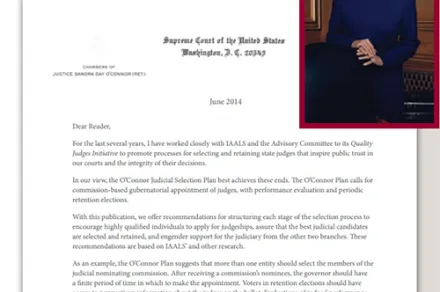
    In recent years, I have been distressed to see persistent efforts in some states to politicize the bench and the role of our judges. Working closely with IAALS and its Quality Judges Initiative, we have collaborated to promote processes for selecting and retaining state judges that inspire public trust in our courts and the integrity of their decisions. Today, I am pleased to share with you the O’Connor Judicial Selection Plan—our recommendations for protecting and strengthening the courts.

    1
  • Procedural Justice: Public Perception of Court and Legal System Legitimacy

    Why do you obey the law? Because you are afraid of the consequences if you don't? Or perhaps because it is the right thing to do? How about, because you believe that "government has the right to dictate to [you] proper behavior"? The third option—believing that government's laws and legal process have legitimacy—may be the keystone to building the most effective legal system.

  • Russell Wheeler Makes a Case for Caution on Federal Judicial Confirmations

    Recent national media coverage paints a highly positive picture of the current pace of federal judicial nominations and confirmations. After all, 2014 has seen 50 confirmations so far, compared to 43 in all of 2013 and 48 in 2012. Not so fast, says Russell Wheeler, an IAALS Board Member and Visiting Fellow at the Brookings Institution. The outlook has improved, but according to Wheeler, a case can be made for a more cautious assessment.

  • Voter Education Effort Featuring Justice O'Connor Wins Emmy Award

    Developed as part of the “Informed Voters – Fair Judges” project, a voter education effort led by the National Association of Women Judges, a short film featuring retired U.S. Supreme Court Justice Sandra Day O'Connor has received an Emmy Award in the Public Service Announcement category from the National Capital Chesapeake Bay Chapter of the National Academy of Television Arts and Sciences.

  • Federal Judge Okays Ohio's Unusual System for Electing Judges

    A federal judge has upheld the unusual system that Ohio uses to elect its judges, which features partisan primary elections and a nonpartisan general election. The challenge to the Ohio system was first filed in 2010 by the Ohio Democratic Party, three judicial candidates, and a public employees union, who claimed that not allowing judicial candidates to run with party labels violated their First Amendment rights.

  • In a Deal with Democrats, Governor Christie Re-Nominates State's Chief Justice

    Ending months of speculation, Governor Chris Christie re-nominated Chief Justice Stuart Rabner to the New Jersey Supreme Court. The move was part of a political compromise with senate leadership, which agreed in exchange to support the nomination of a Christie ally to the supreme court. The deal between Governor Christie, a Republican, and Democrats in the senate will fill one of two seats on a court that has had two vacancies since early 2012.