News & Updates

List of news articles

Showing 181 - 196 out of 196 results for Self-represented litigants

  • Four New Guides

    Unbundling Legal Services: New Resources for Families, Professionals, Lawyers, and Courts

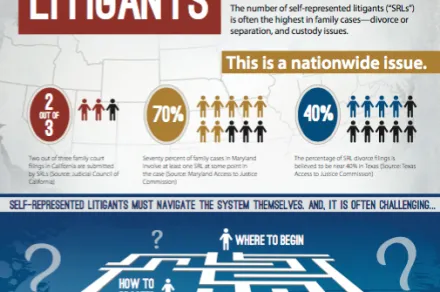
    The number of people representing themselves in court is on the rise, especially in family court. In response to these changing realities, lawyers are increasingly exploring alternative means of delivering their services, so people who need access to legal advice and services are not left behind—and one of these alternative methods is unbundled legal services,

    1
  • Making the Case for Real and Lasting Reform

    Nearly 110 years ago, Roscoe Pound proclaimed: “Dissatisfaction with the administration of justice is as old as the law itself.” In 2015, that sentiment endures and is echoed in the mounting call for real, meaningful change in our civil justice…

  • Alaska Establishes Informal Domestic Relations Trial Program

    The Alaska Supreme Court has issued an Order establishing an informal trial for divorce, property division, parenting agreements, and child support cases. The informal trial process is voluntary. If both parties to a case consent to an informal trial, they will speak directly to the judge and the Rules of Evidence will be relaxed.

    1
  • Self-Represented Litigants and the Struggle to be Heard

    Courts in many countries have been striving to provide various services to help facilitate the increasing number of self-represented litigants who need their services—especially in family law cases. In Ontario, Canada, the National Self-Represented Litigants Project recently published An Open Letter to the Canadian Judiciary, meant to encourage a dialogue between self-represented litigants (SRLs) and judges, who may struggle at times to effectively assist SRLs in their courtrooms.

  • Cases Without Counsel: New Project to Explore Experiences of Self-Representation in U.S. Family Court

    IAALS announces a first-of-its-kind national project to examine the growing trend of American families who represent themselves in family court. The project will include a study of self-represented litigants to discover how family courts can help them navigate the justice system to achieve fair outcomes. Study results will be used to develop recommendations for ways that state courts can meet the needs of those without an attorney.

  • Self-Represented Litigants Create a Two-Tier System

    This issue has created something of a "two-tier system" in which the haves--those with representation--and the have nots--those without--can expect substantially different results in family court cases. This inequality is something that most people would agree is just part of the legal system. But in family court cases it is often the children, not the litigants, who suffer from the inequality.

  • Expert Opinion

    U.S. Access to Justice Gap Garners International Attention and Scrutiny

    Access to justice is by no means a new conversation in the United States, but it has been a frequent topic of conversation over the last few months. The issue took to the international stage last Thursday and Friday when the United Nations Human Rights Committee asked the U.S. to account for its growing civil justice gap, with two worrisome trends dominating the discussion.

  • Insight and Reflection from Judge Elizabeth Starrs on the Denver Domestic Docket

    In a recent article in The Colorado Lawyer, Judge Elizabeth Starrs gives practitioners insight from the bench, including helpful practice tips and an explanation of the Denver domestic relations process. Many of her observations suggest the benefits of a structured, in-court process for domestic relations disputes, with an emphasis on decreasing the adversarial nature of the proceedings—an approach also advocated by the Honoring Families Initiative.

  • Study of Brooklyn Family Court Underway to Improve Service to Self-Represented Litigants

    This summer, the Brooklyn Family Court Child Support Study hopes to improve the quality of legal assistance to self-represented litigants in child custody proceedings. Observers will track whether magistrates explain to self-represented litigants the reason for the hearings, explain the courtroom proceedings, and/or exhibit irritation with the litigants. Then, the observers will follow up with the litigants in a brief interview to discern whether the litigants found the proceeding to be fair and whether they understood what took place in the courtroom.

  • Law Students Help Streamline Divorce Process in Sacramento Court

    A one-day divorce program that launched this spring in the Sacramento Superior Court is streamlining the process for self-represented litigants who have filed a dissolution of marriage case before the Court and are ready for a final judgment. According to the court, law students are playing “a vital role” in the success of the program, meeting with litigants and gathering intake data; the program is also benefiting from the assistance of volunteer attorneys who serve as Judges Pro Tem.