This summer, the legal community lost a giant: Don Scott. Don was a Harvard undergraduate and Yale law graduate whose practice began and grew under the aegis of Kirkland and Ellis. In 1993, Don, Fred Bartlit, Phil Beck, Skip Herman, Jim Palenchar…
With the leadership of Chief Justice Maureen O’Connor, a coalition of groups in Ohio has launched a new website—Judicial Votes Count—to better educate voters in judicial elections. The site offers information about the structure of the Ohio court system and the role of judges in that system, as well as details about how to vote in Ohio.
“Complicated,” “costly,” and “unobtainable” are words that Pope Francis wishes to eliminate from the common description of marriage annulments within the Catholic Church. The pope has issued a new law that sets out a number of changes designed to…
It is no surprise that there is much confusion around how judges get to be judges in the United States. No two states use the same method to select and retain their judges, and even in individual states, the method may vary by the level of court and even location.
Not all divorces are ugly. Shannon and Chris Neuman, a Canadian couple, recently finalized their divorce in Calgary, Alberta. The final consummation of their divorce: a selfie outside the courthouse. The ex-couple’s selfie is a celebration of the…
The California State Bar recently issued a final opinion weighing in on the question of an attorney’s ethical duties in handling the discovery of electronically stored information. In its Formal Opinion No. 2015-193, the State Bar of California…
Navigating federal court without an attorney, self-represented ( pro se) litigants are often lost “in a maze of procedural rules and arcane terminology,” regardless of the strength of their case. However, starting this past March, low-income self…
When the Senate went into recess in August it was on pace to set a new record for fewest judicial confirmations within the final two years of a presidential term, a level not seen since the Eisenhower administration. Russell Wheeler, IAALS Board…
In a recent article in the California Bar Journal, Judge Mark A. Juhas of the Los Angeles County Superior Court described the numerous benefits that unbundled legal services and limited scope representation provide those seeking access to the courts…
The concept of procedural justice has been around for almost half a century and promotes a different style of courtroom interaction. At its core, procedural justice emphasizes that judges be listeners and creative problem solvers. When judges take the time to ensure they explain and are understood, those in their courtroom have a greater likelihood of feeling respected and heard, and the outcomes viewed more positively.
he Quality Judges Initiative at IAALS, along with Justice Sandra Day O’Connor and other members of our advisory committee, has been reaching out to governors of these states to urge them to use nominating commissions when filling court openings that occur between scheduled elections. These vacancy nominating commissions invite applications for open positions, screen and interview the candidates who apply, and recommend a short list of the best qualified to the governor for appointment.
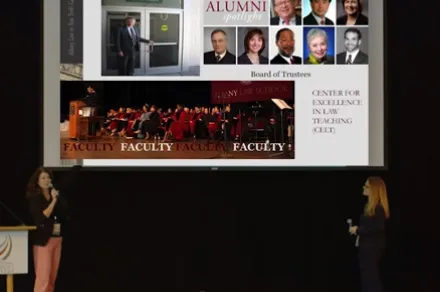
Educating Tomorrow’s Lawyers Director Alli Gerkman was invited to speak on “The Changing Legal Landscape” at the opening plenary session for the National Conference of Bar Presidents in July. In a prepared presentation (below), she said that…
On August 20 and 21, the multidisciplinary Honoring Families Initiative (HFI) Advisory Committee convened in Denver. The meeting agenda included in-depth discussion of preliminary data collected over the last several months as part of the HFI Cases Without Counsel (CWC) project.
The National Self-Represented Litigants Project (NSRLP) in Canada continues to build upon the important initial research conducted by Dr. Julie Macfarlane between 2011 and 2013. Although the original study is over, the group still receives input from…
On the occasion of his retirement, John Lande, now Professor Emeritus at the University of Missouri School of Law and ETL Fellow, collected his advice to law students and lawyers in an essay entitled “My Last Lecture: More Unsolicited Advice for Future and Current Lawyers.”
As of July 1, 2015, Colorado has adopted new amendments to its rules of civil procedure with the goal of achieving a more accessible and efficient road to justice. The amended rules seek to increase the involvement of judges in pretrial activity, limit discovery to what is needed to prove a case, and increase a judge’s ability to award sanctions for noncompliance with the rules.
Washington's inaugural class of limited license legal technicians (LLLTs) have taken their initial test to become the first of their kind. Seven of the nine who took the state's LLLT exam passed and now face the next steps toward becoming licensed…
The Duke Law Center for Judicial Studies has issued a call for public comment on its Guidelines and Suggested Practices for Implementing the 2015 Discovery Amendments to Achieve Proportionality. The Guidelines have their genesis in the Duke Law…
A robust discussion continues in the United States about the need to improve the delivery of legal services. During the American Bar Association’s (ABA) National Summit on Innovation in Legal Services, participants explored ways to bridge the access…
Can the 20th Century model of legal services delivery rise to the challenges and opportunities created by changes in society and the legal industry? And, can clients get the access to justice they deserve through the traditional models of legal…