News & Updates

List of news articles

Showing 41 - 60 out of 85 results for Judicial performance evaluation

  • 10th Anniversary

    Ten Years of IAALS: Building Bridges for Better Judicial Performance Evaluation

    When the Supreme Court of Missouri in January 2008 adopted a rule authorizing The Missouri Bar to create and administer the state’s first true judicial performance evaluation program, the state bar was faced with a very tight timeframe for implementation and a seemingly endless set of questions. How and where do we start? How should the evaluation be conducted? What form should the survey instrument take? What information should be considered by evaluators?

    bridge
  • Press Release

    Judges Aren't Sexy: New IAALS Toolkit Helps States Educate Voters about Judges

    In time for the election season, IAALS today announced a new toolkit designed to educate voters about the performance record of judges up for retention. Judges Aren’t Sexy: Engaging and Educating Voters in a Crowded World is available immediately for states to use in their voter education efforts. In many states, voters have the right to decide which judges stay on the bench and which do not. However, getting readily understandable information about a judge’s record into the hands of voters has been difficult, until now.

    1
  • 10th Anniversary

    Ten Years of IAALS: Why America Needs the O'Connor Judicial Selection Plan

    It has been my honor to participate in IAALS’ Quality Judges Initiative as a member of the O’Connor Advisory Committee. Much of my time serving as President of the American Bar Association in 2008-2009 was devoted to efforts to assure adequate funding for the judicial branch of government and to improve judicial selection in order to assure fair and impartial courts; service on Justice Sandra Day O’Connor’s committee was a logical following step after my term as ABA President ended. As a member of the O’Connor Advisory Committee, I have seen firsthand how QJI brings focus to the national debate on judicial selection issues and challenges. We have members who give perspective to the issues from various diverse backgrounds in order to come up with workable recommendations on judicial selection and judicial performance evaluation.

    1
  • Press Release

    IAALS Celebrates 10 Years of Rebuilding Justice

    This year marks the 10th anniversary of IAALS’ work to continuously improve America’s legal system and reestablish it as the aspirational model for justice globally. To mark this milestone, IAALS celebrates both its accomplishments and its bright future, all while tackling the most critical issues of the day. Having a trusted and trustworthy legal system is essential to our democracy, our economy, and our freedom. IAALS staff, founders, partners, sponsors, and advisors all recognize that to earn that trust, the legal system must be just, impartial, and responsive.


    1
  • 10th Anniversary

    Ten Years of IAALS: A Valued and Trusted Partner in Securing Fair and Impartial Courts

    On the occasion of IAALS’ 10th anniversary, I’ve been reflecting on the strength of our partnership over the years, and on the value of that partnership as our shared work for fair, high quality courts takes on ever-greater significance. Justice at Stake is a nonpartisan, nonprofit organization working to keep America's courts fair and impartial. We work for reforms to keep politics and special interests out of the courtroom—so judges can protect our Constitution, our rights, and the rule of law. As you can see, our mission aligns pretty perfectly with that of IAALS and its Quality Judges Initiative.

    1
  • North Carolina Seeks to Ensure No Biases in Judicial Ratings

    The North Carolina Bar Association is exploring how tweaks in its judicial evaluation process can have real impact on results. As recommended by both the NCSC and IAALS, the latest performance evaluation surveys included a structured free recall exercise that urged attorneys to think of specific experiences with the judges they are about to rate, rather than general impressions, along with both positive and negative aspects of those experiences.

    1
  • Expert Opinion

    Missouri Plan Celebrates 75 Years

    November 2015 is the 75th anniversary of the Missouri Plan, an innovative approach to selecting state judges intended to preserve their impartiality while holding them publicly accountable for their performance on the bench. First adopted by Missouri voters in 1940, this process is now used to select at least some judges in two-thirds of the states.

    1
  • Bar Rating Process for Pennsylvania Judicial Candidates Comes Under Fire

    Pennsylvania is one of two states that is electing supreme court justices in 2015. To provide the public with information about judges on the ballot, the Pennsylvania Bar Association offers ratings of appellate judicial candidates provided by the Bar's Judicial Evaluation Commission (JEC). But, a sitting commonwealth court judge and supreme court candidate has called that evaluation process into question.

  • Expert Opinion

    Toward Impartial and Accountable Judges

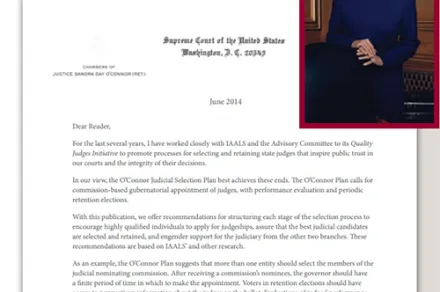
    In recent years, I have been distressed to see persistent efforts in some states to politicize the bench and the role of our judges. Working closely with IAALS and its Quality Judges Initiative, we have collaborated to promote processes for selecting and retaining state judges that inspire public trust in our courts and the integrity of their decisions. Today, I am pleased to share with you the O’Connor Judicial Selection Plan—our recommendations for protecting and strengthening the courts.

    1
  • Alaska Legislators Seek to Change the Way Judges Are Selected

    Republican state legislators have proposed a bill that would increase the size of, and allow the governor to appoint a majority of members to, the Alaska Judicial Council. The AJC serves as both the judicial nominating commission and the judicial performance evaluation commission. Under the new bill, the AJC would be expanded to 16 members, and the change would require amending the constitution.

  • Expert Opinion

    Oklahoma's Judicial Performance Evaluation Proposal Deserves a Closer Look

    HB 3380 would establish a judicial performance evaluation program for Oklahoma’s appellate and trial judges, and is remarkably similar to processes that already operate successfully in seven states where judges appear on the ballot, as they do in Oklahoma. The contemplated JPE program in Oklahoma is objective, broad-based, and apolitical, and an improvement on existing processes.

  • 2014 Could Bring Major Developments for Tennessee Judiciary

    In August 2014, all of Tennessee's appellate judges will appear on the ballot, and voters will decide whether they should be retained in office. By that time, the Judicial Performance Evaluation Commission will have provided information to the public about these judges' performance on the bench. Last month, the commission announced that it may take the unprecedented step of recommending against the retention of three intermediate appellate court judges.

  • Evaluating Our Appellate Judges: Reviewing Performance and Informing Voters

    Appellate judges in 38 states stand for election. But how much do we know about them? Are they fair? Do they write opinions that parties can understand? Are they doing a good job? With only a fraction of states providing such information about appellate judges, very few voters have what they need to make an informed and responsible decision at the ballot box. We at IAALS are working to change that with our newest publication.

  • Expert Opinion

    North Carolina Bar Association Breaks New Ground in Evaluating Judges

    In 2012, North Carolina was the only state with contested judicial elections in which voters were provided with performance evaluations of the judicial candidates—both sitting judges and challengers—on their ballot. It is fairly common for bar associations to offer ratings of sitting judges standing for retention or reelection, but this was the first instance of which IAALS is aware where a bar association also evaluated judicial challengers. Since 2012, the NCBA has also offered a voluntary, confidential evaluation program for new judges.

  • Justice O'Connor Engages with IAALS Leaders, Students, and the Community During Recent Denver Visit

    Justice Sandra Day O'Connor spent a few days last week with us here at IAALS, where we held a meeting of the O'Connor Advisory Committee to the Quality Judges Initiative. Justice O'Connor also engaged in a "fireside chat" under the rubric of the John Paul Stevens Lecture about her life and career. Former Arizona Chief Justice Ruth McGregor and I joined her for the conversation, but it was Justice O'Connor who stole the show.