News & Updates

List of news articles

Showing 241 - 260 out of 340 results for Legal profession

  • Younger Female Lawyers Are Trending Away from Law Firm Jobs

    The Colorado Supreme Court’s Attorney Regulation Counsel recently released statistics on the state’s legal employment, which revealed an interesting trend. According to the Denver Business Journal, the study found that fewer than half of the 1,473 active female attorneys younger than 30 years old are working in law firms of any size, and only 20 percent of female attorneys in that age range went to work for big law firms. At the same time, law school classes around the country are fairly equally divided between male and female students, on average.

    1
  • Expert Opinion

    The Whole Lawyer: Small Variations among Law Firm Sizes (And Conclusion)

    In the last blog, we explained that the 77 foundations survey respondents identified as being necessary for new lawyers in the short term are largely consistent and definitive across respondents. Still, there were a few differences that highlight foundations some practice settings emphasize over others. Similarly, when we focused on private practice, we discovered only slight variations among different law firm sizes. In this blog, we explore the foundations that make up the whole lawyer for each private practice firm size category, and the differences as compared with one another and the whole lawyer overall.

    1
  • Expert Opinion

    The Whole Lawyer: Small Variations Across Practice Settings

    In our previous blog, we explained that the 77 foundations survey respondents identified as being necessary for new lawyers immediately upon graduation from law school are consistent and definitive throughout the practice of law. The similarities we saw in responses across demographics, firm sizes, and practice-specific characteristics suggest that the findings can be employed with confidence by law schools, the profession, employers, and others to facilitate the development of crucial foundations needed by lawyers right out of law school. Nonetheless, there were a few notable practically significant differences that arose among the various practice settings we studied.


    1
  • Annual Report

    Action to Justice: IAALS 2017 Annual Report

    We are proud to present you with IAALS' 2017 Annual Report, showcasing our efforts to help create a legal system that works for everyone. The theme this year is “Action to Justice.” Throughout the report, you will see images that are straight out of the comics. But despite the whimsical tone, the real message is that we live in times that pose great challenges to our system of justice, and superheroes must answer the call to act.

    1
  • The Whole Lawyer: Consistent Across All Workplaces

    In July 2016, IAALS published Foundations for Practice: The Whole Lawyer and the Character Quotient, which shared findings from a survey that asked more than 24,000 lawyers what new lawyers need as they enter the profession. In the survey, we also collected from respondents ten demographic and practice-specific characteristics. We thought we might observe interesting, informative, and actionable differences across these demographics and characteristics. However, as we conducted analysis of the survey data for our reports, it became clear that our expectation was misplaced.

    1
  • Wisconsin Bar Highlights Foundations for Practice Study

    The Wisconsin Lawyer recently reviewed IAALS' Foundations for Practice study and discussed some of its ties to Wisconsin's legal community. Of the more than 24,000 lawyers nationwide who participated, 500 were from Wisconsin. In the first part of the survey, at least three-fourths of those respondents said that characteristics were vital for new lawyers to have right out of school, while professional competencies and legal skills were less immediately valuable. Alli Gerkman, the director at IAALS who oversees the Foundations project, emphasized that the survey suggests that legal skills were still important, but new lawyers do not need to have them all mastered right out of law school.

    1
  • Why the Litigant Experience Matters to Lawyers—and Law Schools

    Nicole Bradick is a lawyer, Chief Strategy Officer at CuroLegal, and an advocate for expanding access to justice. As she writes in a recent post at Lawyerist, she was a federal court litigator for eight years and had some exposure to state court pro bono cases, but her observational visit to an eviction court this summer was the first time she ever observed such a court from the self-represented litigant’s perspective. Her verdict? “Eviction court really, really sucks.” Bradick writes that she was dismayed by the treatment of the litigants and an environment that fosters imbalance, and that she was “[e]mbarrassed because in all my time practicing law, I never bothered to sit in court and feel what it’s like in the shoes of a self-represented litigant.” She is, of course, not the only one.

    1
  • To Be a Good Lawyer, One Has to Be a Healthy Lawyer, New Report Finds

    It is common knowledge that many lawyers and law students struggle with high stress as well as high rates of depression and substance abuse. Now, the American Bar Association’s National Task Force on Lawyer Well-Being is suggesting that these characteristics interfere with the legal profession's dedication to serving clients and dependence on the public’s trust.

    1
  • IAALS' First-of-its-Kind Study Will Determine What Clients Value in Their Lawyers

    What do clients want from their attorneys? The answers to that question would seem to be key to understanding how to improve the quality and diversity of legal services. Identifying what clients value in their lawyers has been a challenge because clients are difficult to identify and survey. But, now we have a source of precisely the information we need. IAALS, the Institute for the Advancement of the American Legal System, is partnering with Avvo, an online legal services marketplace, on a new project: “Think Like a Client.” This first-of-its-kind effort was announced today from the 6th Annual Educating Tomorrow’s Lawyers Conference.

    1
  • 6th Annual #ETLConference Focuses on Addressing Client Needs

    Hello! My name is Heather Buchanan, and I am a second-year law student at the University of Colorado Law School in Boulder. I am thrilled to be attending the 6th Annual Educating Tomorrow's Lawyers Conference in Denver this Thursday, Friday, and Saturday (October 5–7). The theme of this year's conference is "Educating Tomorrow's Lawyers... to Serve Tomorrow's Clients," which will focus on client needs, improvements in delivering legal services, and—most importantly—ways to bring those concepts into law schools to better prepare the next generation of lawyers.

    1
  • LawyerSlack Part 2: Prioritizing Life Experiences, Grit, Customer Service

    With nearly 30 percent of lawyers responding to our Foundations for Practice survey indicating that “life experience between college and law school” was “very helpful” (and another 49 percent saying it was “helpful”), why don’t lawyers discuss these experiences more on resumes or in interviews? The focus generally is to keep their background “strictly legal,” but the Foundations survey indicates that employers are looking for new hires that have grit, work ethic, and experience. And if you’re a young lawyer, likely the only place you can draw on past experience is non-legal jobs.

    1
  • ETL Director Alli Gerkman Raising the Bar with CWBA Foundation Award

    Last night, Educating Tomorrow’s Lawyers Director Alli Gerkman was honored at the 12th Annual Raising the Bar Dinner hosted by the Colorado Women’s Bar Association Foundation. Each year, the CWBA Foundation honors women lawyers “who have made a difference in our communities and have ‘raised the bar’ for all of us.” With over 400 people in attendance, Alli was honored along with four other women attorneys for their work to raise the bar through reform or innovation “that has significant systemic impact.”

  • Guest Blog

    Design Thinking: Explore New Ways of Solving Problems at the 2017 ETL Conference

    At next month's Educating Tomorrow's Lawyers Conference, we will spend Saturday morning in a Design Thinking workshop. It will be a hands-on way to learn what a design approach is, for you to use as an experiential teaching method or as a problem-solving process. When you hear the word “design,” you might assume this method is all about visuals, making things look nice, and choosing the best PowerPoint themes. Good visual design is important. But “Design Thinking” focuses not so much on visuals, as on solving problems in more human-centered and experimental ways. It's about understanding a challenge area from different stakeholders' perspectives, and then quickly building and testing new solutions to see which have the greatest promise.

    1
  • LawyerSlack: An Informal Survey of Career Paths, Helpful Jobs, What to Avoid

    A while back, Alli Gerkman wrote about the importance of life experience for new lawyers. But lawyers often don’t discuss these experiences on resumes or in interviews. They try to keep their background “strictly legal.” But the Foundations for Practice survey indicates that employers are looking for new hires that have grit, work ethic, and experience. And if you’re a young lawyer, likely the only place you can draw on past experience is non-legal jobs. Along those lines, I recently asked the people in LawyerSlack.com (the largest, private, lawyers-only Slack community) about their work history and experience.

    1
  • Igniting Innovation: First Day Presenters Announced for 2017 ETL Conference

    The 6th Annual Educating Tomorrow’s Lawyers Conference is right around the corner! In addition to our fantastic lineup of program speakers, we are excited to have fifteen Ignite presentations from a broad swath of law schools and legal organizations. As you may know, it has become ETL Conference tradition to kick off the first day of the conference with a series of Ignites. Presenters have 6 minutes, 20 slides, and 18 seconds per slide to share their projects, successes, and ideas.

    1
  • ABA Adopts Resolution Supporting Trial Experience for Young Lawyers

    At its annual meeting this week in New York City, the ABA House of Delegates adopted Resolution 116 urging courts to implement plans that provide meaningful courtroom experience to new lawyers. The resolution—recognizing the important role law firms and clients play in the experience, or lackthereof, that young lawyers receive—also urges law firms and clients to take advantage of those plans.

  • Expert Opinion

    We May Soon Know Less About Employment Outcomes for New Lawyers

    In the name of simplicity, the ABA Council for the Section of Legal Education and Admissions to the Bar approved a proposal to roll back transparency in employment outcomes for law school graduates in a process that, itself, is under attack for its lack of transparency. Simplicity is a good thing, but not when it risks mischaracterizing important facts. Understanding how law graduates are employed is critical for prospective students, current students, law schools, and the profession—and under this approved proposal, we would know less than we do now.

    1
  • UPDATED: California Prepares to Potentially Lower Its Bar Exam Pass Score

    The California State Bar recently released the results of a study on the state bar exam’s current cut score, or pass line. The study, which was accelerated in order to possibly apply a new score to the July 2017 exam, suggests two possible options for addressing concerns that the exam may be too hard: 1) Leave the pass line at its current score of 1440 (144 on the 200-point scale), or 2) Set an interim pass line of 1414 (141.4 on the 200-point scale). The Committee of Bar Examiners and the Board of Trustees’ Admissions and Education Committee voted to adopt the study and to collect public comments on both options until August 25.

    1
  • Better Access through Unbundling: IAALS and ABA Host Conference on Implementation

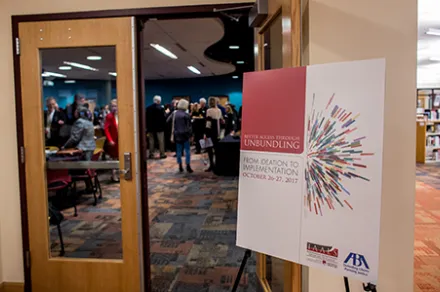
    The legal industry is changing. In some courts, upwards of 80% of civil and family cases involve litigants who are navigating the court system without any form of legal assistance. Research has confirmed that the primary reason so many do not have the benefit of a lawyer is because of cost. The inability to afford an attorney is no longer an issue confined to low-income Americans. Increasingly, middle-class litigants are finding themselves priced out of legal services as well. In addition, even litigants who can afford an attorney may choose to opt for self-representation in order to maintain a certain level of control over their legal matters or to keep the costs of such services down.

    1