News & Updates

List of news articles

Showing 541 - 560 out of 2118 results

  • IAALS Advances Justice with Attorney John Moye

    John Moye is one of a kind: brilliant and indomitable. IAALS itself was the result of alchemy—a coalition between John, Dan Ritchie, Charlie Gates, and me—and it began over a dinner at a Denver restaurant in the spring of 2005. John and I started talking about “what if.” John, like the other IAALS founders, has never heard the words “it cannot be done,” and IAALS was no exception. 

    1
  • Convening Highlights the Role of Judges and Lawyers in Improving Motions Practice

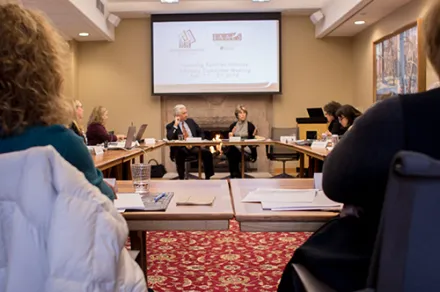
    While a significant focus of civil justice reform has been on the cost and delay of discovery, IAALS has heard the call for reform in the area of motions practice as well, which can similarly result in great cost and delay to the parties. In response, IAALS hosted a convening earlier this month at the Penrose House in Colorado Springs, Colorado, devoted to addressing the current challenges in dispositive motions practice.

    1
  • 2018 Law School Rankings Released by Princeton Review

    Princeton Review released their 2018 law school rankings at the end of October—top 10 lists with categories like “Best Classroom Experience,” “Most Competitive Students,” and “Best Career Prospects.” Many of the rankings are based on student feedback; in fact, 10 of the 11 categories either feature or are based entirely on responses to a student survey (“Toughest to Get Into” is the only category based wholly on institutional data). The surveys asked students about professors’ teaching ability and accessibility, number of hours spent studying, diversity, sense of community, and opportunities for externships, internships, and clerkships, among many other topics.

    1
  • Colorado Judges Teach Civics to the Public

    In a society where only 26 percent of adults can name all three branches of the federal government and a third cannot even name one, Colorado's judicial branch has sought to improve its citizens’ civics knowledge through Our Courts Colorado. The nonpartisan program provides civics education presentations in both English and Spanish for adults in their communities across the state, many given by state and federal judges.

    1
  • To Be a Good Lawyer, One Has to Be a Healthy Lawyer, New Report Finds

    It is common knowledge that many lawyers and law students struggle with high stress as well as high rates of depression and substance abuse. Now, the American Bar Association’s National Task Force on Lawyer Well-Being is suggesting that these characteristics interfere with the legal profession's dedication to serving clients and dependence on the public’s trust.

    1
  • Unbundle Now: Taking Limited Scope Representation Mainstream

    For young legal practitioners, integrating limited scope representation into law school curriculums is a giant step toward increasing awareness and mastery of modern legal practice. This was the position of the “Unbundling for the Next Generation” panel at the IAALS/ABA Better Access through Unbundling conference on the University of Denver campus last month. Professors Andrew Schepard, Danielle Hirsch and Luz Herrerra presented on the benefits of integrating limited scope representation into clinics and experiential classes, law school incubators, and bar events that target young lawyers, as well as educating court staff to promote referral panels.

    1
  • Denver to Host Jury Improvement Luncheon

    The Civil Jury Project at NYU School of Law, whose Executive Director is Steve Susman, is organizing a Jury Improvement Lunch for the Colorado bench and bar this Thursday, November 2. The goal of the lunch is to honor jurors who have recently served by inviting them to attend a lunch with judges and lawyers in the community to share their experiences and to learn from them about what can be done to improve civil trials. These education programs, dubbed “Jury Improvement Lunches,” began in Texas and have been held in Houston, Dallas, and Corpus Christi. In addition to Denver, the project is now organizing similar lunches in Boston, Baltimore, San Francisco, Kansas City, Seattle, Oklahoma City, and Cleveland.

    1
  • The Topsy Turvy World of North Carolina’s Courts

    This week, the North Carolina Senate created the new Senate Select Committee on Judicial Reform and Redistricting to consider various options for how the state selects judges. The committee’s formation comes after the North Carolina legislature took several steps recently to shake up the state's judicial system. Back in March, the legislature voted to override the governor’s veto of House Bill 100, which requires North Carolina Superior Court and District Court judges to identify their party affiliation on ballots. Proponents of the bill say voters want to know everything they can about judicial candidates when they vote. Opponents, like the governor, argue the bill politicizes the courts.

    1
  • IAALS Advances Justice with Duane Morris LLP’s Sheila Hollis

    From her 5’3” frame, Sheila Hollis has cast a long shadow in the law, as a trailblazer, innovator, and international leader. She is Colorado grown and educated, and now has deep roots in our nation’s capital, where she brokers with the best of them. I had an initial “taste” of that at our very first dinner together in Washington, D.C., at a restaurant that she frequents often, where she knows the menu, the wine list, the staff, and many of the patrons. I felt like I was getting a peek at the in-crowd.

    1
  • Commission on Future of California Court System Recommends Innovations

    Over the last three years, California has undertaken an effort to “research and analyze innovative proposals for the justice system of the future.” The work has culminated in a final report that was submitted to the Chief Justice on April 26, 2017. The report from the Commission on the Future of California’s Court System focuses on practical ways to more effectively adjudicate cases, achieve greater fiscal stability, and use technology to enhance the public’s access to the courts. The breadth of the report is tremendous, making sweeping recommendations in criminal law, civil law, family law, court administration, and technology.

    1
  • Expert Opinion

    Lawyers and Technology: A Combination to Improve Access to Justice

    Technology has radically altered how legal help is sought—and how it is delivered—yet there is still an overwhelming need for affordable and accessible legal services in the United States. This gulf can only be bridged when attorneys adopt new ways of approaching the practice of law and the delivery of legal services.

    1
  • IAALS' First-of-its-Kind Study Will Determine What Clients Value in Their Lawyers

    What do clients want from their attorneys? The answers to that question would seem to be key to understanding how to improve the quality and diversity of legal services. Identifying what clients value in their lawyers has been a challenge because clients are difficult to identify and survey. But, now we have a source of precisely the information we need. IAALS, the Institute for the Advancement of the American Legal System, is partnering with Avvo, an online legal services marketplace, on a new project: “Think Like a Client.” This first-of-its-kind effort was announced today from the 6th Annual Educating Tomorrow’s Lawyers Conference.

    1
  • Arizona Supreme Court Approves Civil Justice Reforms

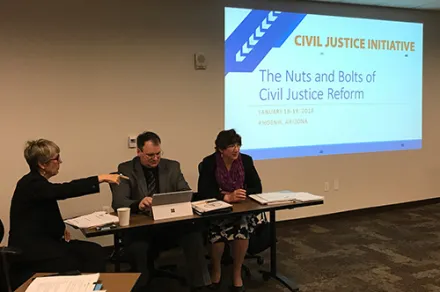
    Arizona’s Supreme Court has approved numerous civil justice reforms “aimed at reducing the time and expense it takes to resolve civil cases in Arizona’s superior courts.” The reforms are based on the recommendations of Arizona’s Civil Justice Reform Committee, which was established by the Arizona Supreme Court in December 2015 to “develop recommendations, including rule amendments or pilot projects, to reduce the cost and time required to resolve civil cases in Arizona’s superior courts.”

    1
  • 6th Annual #ETLConference Focuses on Addressing Client Needs

    Hello! My name is Heather Buchanan, and I am a second-year law student at the University of Colorado Law School in Boulder. I am thrilled to be attending the 6th Annual Educating Tomorrow's Lawyers Conference in Denver this Thursday, Friday, and Saturday (October 5–7). The theme of this year's conference is "Educating Tomorrow's Lawyers... to Serve Tomorrow's Clients," which will focus on client needs, improvements in delivering legal services, and—most importantly—ways to bring those concepts into law schools to better prepare the next generation of lawyers.

    1
  • Judge Posner, Self-Represented Litigants, and Changing Our Legal System

    By now, the word is out that Judge Richard A. Posner is retiring from the 7th Circuit Court of Appeals. His retirement was unexpected, but his stated reasons for doing so shouldn’t be. In correspondence announcing his departure, Judge Posner sites apparent “difficulty” with his colleagues on the bench over the treatment of self-represented litigants as the motivation to leave the bench. A prompt response from Chief Judge Diane P. Wood, also on the 7th Circuit Court of Appeals, countered Judge Posner’s claim by stating, in part, “the judges and our staff attorneys take great care with pro se filings.” Judge Posner’s point, though, is more indicative of the entire justice system than a particular court and its staff attorneys.

  • IAALS Advances Justice with the Brookings Institution’s Russell Wheeler

    Russell has been with IAALS from the first moment. He came to us at the recommendation of Judge Richard Matsch of the Federal District Court in Denver. Russell had just left his position as Deputy Director of the Federal Judicial Center and joined the Brookings Institution’s Governance Studies Program. Judge Matsch told me that if we could get Russell on our Board, we would have won the lottery. And indeed, we did. Russell has been our secret weapon—our empirical conscience. 

    1
  • Experiential Learning a Top Factor for Law School Applicants

    When law school applications took a downturn around 2011, some law schools redesigned their curricula to add more experiential learning opportunities. Aimed at ensuring that their students were prepared for practice after graduation—and improving their graduates' chances of getting hired—schools hoped the refocused offerings might attract more applicants. In the midst of this shift, David Thomson and Stephen Daniels planned a three-year study of students at the University of Denver Sturm College of Law. The results were published recently in an article titled, "If You Build it, They Will Come: What Students Say About Experiential Learning."

    1
  • LawyerSlack Part 2: Prioritizing Life Experiences, Grit, Customer Service

    With nearly 30 percent of lawyers responding to our Foundations for Practice survey indicating that “life experience between college and law school” was “very helpful” (and another 49 percent saying it was “helpful”), why don’t lawyers discuss these experiences more on resumes or in interviews? The focus generally is to keep their background “strictly legal,” but the Foundations survey indicates that employers are looking for new hires that have grit, work ethic, and experience. And if you’re a young lawyer, likely the only place you can draw on past experience is non-legal jobs.

    1
  • ETL Director Alli Gerkman Raising the Bar with CWBA Foundation Award

    Last night, Educating Tomorrow’s Lawyers Director Alli Gerkman was honored at the 12th Annual Raising the Bar Dinner hosted by the Colorado Women’s Bar Association Foundation. Each year, the CWBA Foundation honors women lawyers “who have made a difference in our communities and have ‘raised the bar’ for all of us.” With over 400 people in attendance, Alli was honored along with four other women attorneys for their work to raise the bar through reform or innovation “that has significant systemic impact.”