Publications

List of publications

Showing 1 - 20 out of 21 results for 243

  • cover

    Recommendations for Judicial Discipline Systems

    In this report, we make recommendations for judicial discipline systems that are designed to achieve a balance between transparency and accountability, confidentiality and trustworthiness—all with the goal of enhancing public trust and confidence in the judges of this nation.

  • 1

    Court Compass: Mapping the Future of User Access through Technology

    Our studies show that the court system does an insufficient job helping people navigate their way through the system to resolution. People feel frustrated, lost, disempowered, and disillusioned by our legal system, especially self-represented litigants. In an effort to address this issue, IAALS' Court Compass project intends to create a shared base of information that will allow us to move toward solutions.

  • 1

    A Court Compass for Litigants: 2016 Convening Report

    In June 2016, IAALS convened a group of people from around the country to discuss the development of an online tool designed to help people with potential legal problems in the family court arena and to help self-represented litigants with these kinds of cases in court. This paper is the outgrowth of that convening and details next steps in a plan designed to coalesce energy and funding toward achievement of such an online tool.

  • Report cover

    Rule Reform, Case Management, and Culture Change

    Making the Case for Real and Lasting Reform

    In this article for the Kansas Journal of Law and Public Policy, IAALS highlights the critical next step needed beyond rule changes: culture change. Judges and attorneys alike have a responsibility to ensure that the system functions well, for the sake of clients, courts, and the profession. This article outlines those responsibilities and ways to achieve that goal.

  • Choosing Judges: Judicial Nominating Commissions and the Selection of Supreme Court Justices

    Choosing Judges: Judicial Nominating Commissions and the Selection of Supreme Court Justices

    This report details the judicial nominating commissions used to select supreme court justices in 30 states and the District of Columbia. The report examines why judicial nominating commissions are established in the first place, how their structure and operation differ across the nation, and what some of the best practices might be in building public trust in the process.

  • Courts and Communities Helping Families in Transition Arising from Separation or Divorce

    Courts and Communities Helping Families in Transition Arising from Separation or Divorce

    This white paper describes the premises and policies for the Honoring Families Initiative (HFI) at IAALS. The goal of the paper and, more broadly, of HFI’s projects, is to offer new models of service delivery in order to facilitate an informed national dialogue on how courts and communities can better meet the needs of parents and children that arise from the transitions of separation or divorce.

  • The American Civil Justice System: From Recommendations to Reform in the 21st Century

    The American Civil Justice System: From Recommendations to Reform in the 21st Century

    Kansas Law Review

    In this article we explore the history of recent efforts to improve the civil justice system in the United States, beginning first with the efforts of IAALS and the American College of Trial Lawyers Task Force on Discovery and Civil Justice, which culminated in a Final Report that proposed twenty-nine Principles containing broad ideas to improve the civil justice system.

  • It Is Just Good Business: The Case for Supporting Reform in Divorce Court

    It Is Just Good Business: The Case for Supporting Reform in Divorce Court

    This article examines the ways in which familial distress surrounding separation and divorce can affect individual employee productivity and negatively impact a business' bottom line. This article further outlines some improvements that are being implemented or considered in various jurisdictions.

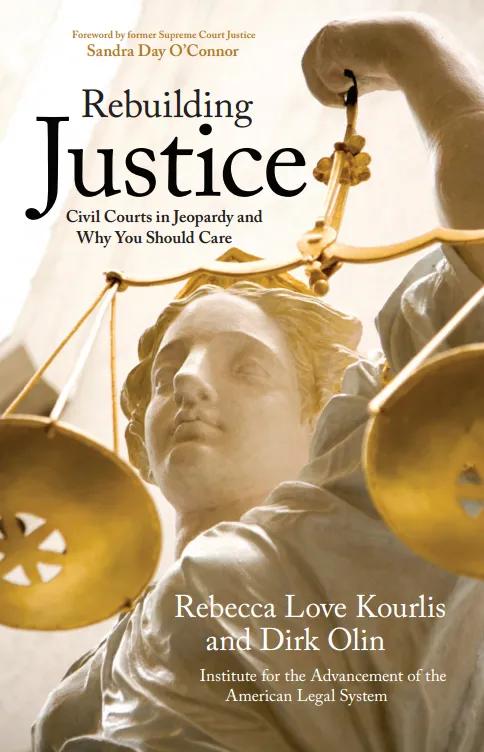
  • Rebuilding Justice: Civil Courts in Jeopardy and Why You Should Care

    Rebuilding Justice

    Civil Courts in Jeopardy and Why You Should Care

    Authors Rebecca Love Kourlis and Dirk Olin tell the story of a civil justice system that has become alarmingly expensive, politicized, and time-consuming, degrading it to the point that it no longer meets the legitimate needs of the people it was created to serve.

  • Options for Federal Judicial Screening Committees, Second Edition

    Options for Federal Judicial Screening Committees

    Where They Are in Place, How They Operate, and What to Consider in Establishing and Managing Them

    This report describes the committees in place and their significant variations in membership, appointment process, and, to the degree possible, operations. It suggests why senators and their staffs might consider using a committee, outlines decisions they might face in structuring and appointing a committee, and identifies issues they and committee members might encounter in operating a committee.


  • Civil Justice at a Crossroads

    Civil Justice at a Crossroads

    Keynote Address

    In this keynote address, IAALS Executive Director Rebecca Love Kourlis describes the ambivalence to skyrocketing costs, unprofessional gamesmanship, and long delays in civil litigation a decade ago, and the legal profession's cynicism about our inability to alter any of those factors. However, all that has changed.

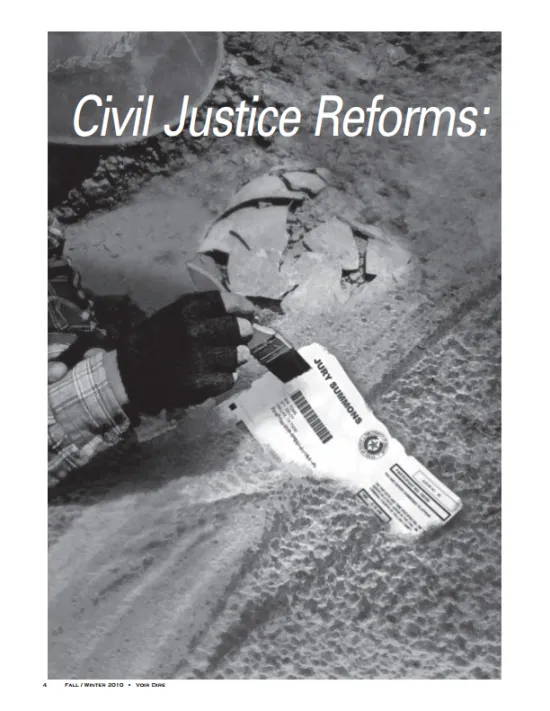
  • Civil Justice Reforms: Why the Disappearance of Civil Jury Trials is Not Acceptable

    Civil Justice Reforms

    Why the Disappearance of Civil Jury Trials is Not Acceptable

    Those who are involved in the civil jury process know first-hand of the genius and value of trial by jury. To preserve and restore the civil jury trial, we must make the pretrial process faster, cheaper, and more user-friendly. The focus of this article will be to highlight a pilot project proposal under development in Colorado to do just that.

  • Reinvigorating Pleadings

    Reinvigorating Pleadings

    Denver University Law Review, Vol. 87, No. 2, p. 245

    Pleadings are the gateway to the American civil justice system. Parties must be able to afford to stay in the system long enough to narrow their disputed issues and collect relevant evidence for presentation to a judge or jury.

  • New Report Establishes Principles for Improving the U.S. Civil Justice System

    New Report Establishes Principles for Improving the U.S. Civil Justice System

    Judicature, Vol. 93, No. 3, p. 121

    This article summarizes our results of a survey of Fellows of the American College of Trial Lawyers. The survey collected the opinions of nearly 1500 experienced litigators, representing both plaintiffs and defendants, on a wide range of issues concerning the civil justice system and the pretrial process.

  • A Strategy for Judicial Performance Evaluation in New York

    A Strategy for Judicial Performance Evaluation in New York

    Albany Law Review, Vol. 72, No. 3, p. 655

    In this essay, we describe how Judicial Performance Evaluation programs work, consider what lessons those programs offer for judicial screening and judicial selection in New York, and explain how both the citizens and judges of New York would benefit from an official, comprehensive JPE program.

  • Managing Toward the Goals of Rule 1

    Managing Toward the Goals of Rule 1

    Federal Courts Law Review, Vol. 2009, No. 2

    Two new studies may help federal judges better achieve the objectives of Rule 1 of the Federal Rule of Civil Procedure—a “just, speedy, and inexpensive” resolution of civil cases.

  • America’s Judicial Selection Wars

    America’s Judicial Selection Wars

    ABA Human Rights Journal, Vol. 36, No. 1

    Politicians are supposed to be aligned with an ideology. In contrast, judges must decide each case on its merits, not on the basis of political ideology or a campaign contribution. There are two common methods for selecting judges: elections and merit selection. We have only to look at this past election season to understand how these methods support or undermine the ideal of an impartial American judiciary.

  • A Performance Evaluation Program for the Federal Judiciary

    A Performance Evaluation Program for the Federal Judiciary

    Denver University Law Review

    This article begins with a discussion of the purpose and design of JPE programs, gleaned from more than thirty years of experience at the state level. It explores the sporadic history of federal JPE, proposes a series of pilot studies to test different methods of implementing JPE programs, and discusses some of the more challenging issues presented by the establishment of a federal JPE program.

  • A Fresh Look at Judicial Performance Evaluation in California

    A Fresh Look at Judicial Performance Evaluation in California

    California Courts Review

    Judicial Performance Evaluation has the potential to help dissipate attacks on judicial impartiality and independence by focusing the public on process-oriented judicial skills and away from specific case outcomes.