

Closing the Gap: Expanding the Legal Ecosystem for the Middle Class

For millions of Americans, needing a lawyer means going without one. Research by IAALS and by the Legal Services Corporation confirms what many already experience: affordable legal help is out of reach for many individuals and small businesses. This gap is not limited to those who qualify for legal aid—it extends into the middle class.
The graphic below illustrates the “Above the Line” problem. Rain represents legal problems Americans typically face, and the umbrellas represent access to legal help.
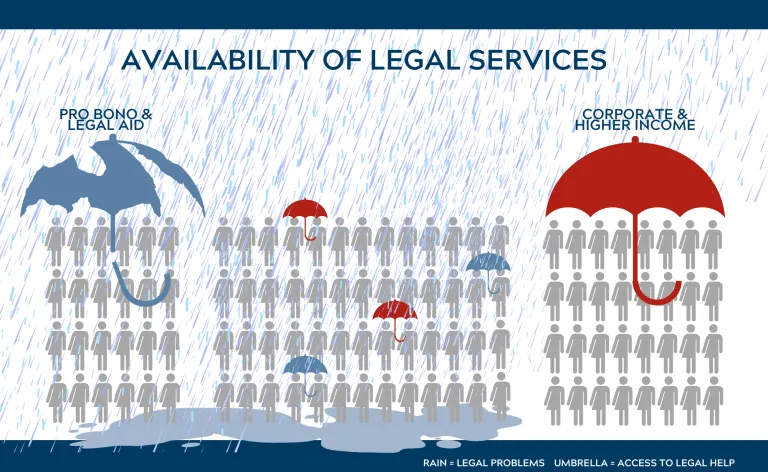
On the left, individuals who qualify for free legal aid stand beneath a leaky umbrella, symbolizing a system stretched too thin to meet demand. In contrast, on the right, corporate and higher-income clients are fully covered by a competitive and high-functioning legal market.
Between those two groups sits the middle class, which faces distinct challenges. They make too much money to qualify for free legal aid, but generally can’t afford the services of lawyers and firms serving the corporate and higher-income market. As a result, many face legal problems with little to no protection at all. A select few, though, do have umbrellas over their heads, representing the limited areas of the legal market that function relatively well for the middle class, such as higher value personal injury cases and real estate transactions. Most people and small businesses, however, struggle to find affordable legal help when they need it.
Root Causes in the Gap for Legal Services for the Middle Class
To understand why the middle class struggles to access affordable legal help, Professor William D. Henderson, the Stephen F. Burns Chair on the Legal Profession at the Indiana University Mauer School of Law, shared compelling ideas and data at the launch of the Above the Line Network during the Tackling Root Causes & Overcoming the Middle-Class Access to Justice Problem webinar. According to Professor Henderson, there are three root causes for the gap in legal services for the middle class.
- Our regulatory structure is rooted in separation of powers.
The legal profession is the only industry that is regulated by the judiciary. It’s a self-regulated profession, with its market structure shaped by each state’s rules of professional conduct and unauthorized practice of law statutes. Additionally, in most states, only lawyers are licensed to practice law and deliver legal services. Anyone who is not a lawyer or otherwise not permitted to give legal advice can oftentimes be criminally prosecuted. Although state supreme court justices serve as the ultimate regulators, they have not been trained as market regulators and often lack the time required to oversee such a complex industry. For the latter reason, state supreme courts often look to the organized bar for assistance, thus creating a self-regulated industry. When the regulated are also the regulators, this creates inherent conflicts of interest and little incentive for them to make changes that could potentially adversely affect them, even if the changes were better for consumers.
- The legal profession suffers from lagging legal productivity (“cost disease”).
In labor and knowledge intensive industries, the cost of services rises without any gains in productivity. Because law is a labor-intensive and stagnant sector where the primary product is a lawyer’s specialized judgment, it cannot easily achieve the massive, technology-driven productivity leaps seen in manufacturing or software. Consequently, as the rest of the economy becomes more efficient, the relative cost of traditional legal services climbs, making them increasingly unaffordable for the average consumer. Additionally, legal consumers are valuing legal services less than healthcare services and education and thus less likely to allocate money to them.
Together, lagging legal productivity and the decline in the perceived value of legal services have contributed to a near 50% shrinkage in the people law sector—the part of the market serving individuals and small businesses. A smaller market means less options for the middle class.
- Our justice system has multiple fail points, not just a broken front door.
Unfortunately, there are multiple, compounding fail points in our justice system that prevent individuals and small businesses from accessing legal help. The biggest failure point is that 50% of people with a legal problem do not recognize that their problem has a legal solution and do not know to seek out legal help. The legal profession needs to do a better job of educating the public about legal needs and meeting them where they are when they are experiencing legal issues.
Second, practitioners serving individuals and small businesses largely do not have the skills to design, build, and deliver cost-effective, scalable solutions. Unlike lawyers working in big law firms, they don’t have the money to hire professionals with these skills.
Third, our court system was designed to have lawyers on both sides of every case. But today, in many courtrooms, a significant majority of cases have at least one unrepresented party. This results in severe case backlogs within our court system.
While these root causes present real challenges that require a multi-pronged approach paired with substantial support from every stakeholder group within the legal profession, they also help explain why new models, providers, and delivery approaches have emerged to better serve the middle market.
The Growing Ecosystem of Models and Providers
Although these structural challenges are significant, they have also catalyzed innovation across the legal services landscape, driving the development of new models and providers aimed at better serving middle-market consumers and small businesses.
Over the past decade, we have started to see notable growth within the delivery of legal services ecosystem as the number and variety of models and providers has increased. Rather than having a few options for accessing legal help, middle-market consumers and small businesses now have more choices when they don’t qualify for legal aid.
Together, these models below represent a growing ecosystem responding to the structural barriers that have long limited access to legal help for the middle market.
- Legal First Aid. Legal Link, a nonprofit organization located in the San Francisco Bay Area, has developed curriculum and web-based tools for training community-based organizations across the country how to spot legal issues and provide targeted legal information and referrals.
- Legal Aid Organizations Who Serve Over-Income Clients. There are several legal aid organizations across the country that have developed programs for serving people who do not traditionally qualify for legal aid. One example is Jacksonville Area Legal Aid’s Family Law Assistance at Reduced Expense (FLARE) program, which provides legal help at reduced expense to moderate-income families with family law issues.
- Court Navigators, Self-Help Centers and Online Portals, and Law Libraries. Self-represented litigants of all income levels can access the growing number of court navigator programs, self-help centers, online legal help portals, and law library programs across the country. Many of these programs continue to grow in size and scope each year. One example is the Maryland Center for Legal Assistance (MCLA). MCLA is a court-funded initiative that provides free, compassionate, innovative, and high-quality legal services through comprehensive legal advice, education, and collaboration with community partners. It operates statewide with phone, email, chat, and in-person assistance at courthouses.
Legal Document Preparers. In Arizona, the Legal Document Preparer Program certifies people in Arizona who are not lawyers to provide document preparation assistance and services to individuals and entities not represented by an attorney. Legal document preparers may provide general legal information but may not give legal advice. There are several hundred participants in the program.
- Community Justice Workers and Legal Advocates. Community justice workers (CJWs) and Community Legal Advocates (CLAs) are non-lawyers working at community-based organizations who are trained and certified to offer limited scope legal advice and services. Think of this category of providers as the EMTs of the legal profession. There is a diverse landscape of them sprouting up across the country.
- Law School Clinics. Many law school clinics focus their work on serving individuals and small businesses that make too much money to qualify for legal aid but not enough money to hire a private attorney at market rate (e.g., Texas A&M University School of Law legal clinics). Some are building pipelines to increase the number of practitioners in rural areas (e.g., University of Nebraska College of Law’s Rural Law Opportunities Program).
- Justice Tech Companies. A growing number of entrepreneurs are leveraging technology to deliver legal services and expand access to justice for all. You can learn about many of them on the Justice Technology Association’s Member Directory.
- Sliding Scale and Non-Profit Law Firms. This model is proving to be an effective approach to serving people who are just over the income eligibility line for legal aid. Sliding scale and non-profit law firms typically charge lower fees, sometimes on a sliding scale basis, based on income. If they cannot cover their expenses through fee generation, they subsidize their work through other funding streams. Examples of sliding scale law firms include the DC Affordable Law Firm, The Commons Law Center, Charleston Legal Access, Inner Banks Legal Services, Chicago Advocate Legal, and Bridge to Justice.
- Authorized Representatives. For decades, people who are not lawyers and who have various levels of accreditation can assist parties in many federal and state administrative proceedings. The most well-known example is Accredited Representatives in immigration proceedings.
- Allied Legal Professionals. “Allied legal professionals” (ALPs) is the term IAALS currently uses to describe a tier of providers who are the nurse practitioners of the legal profession; IAALS is working to standardize a national title for these practitioners, with recommendations coming soon. ALPs are trained and licensed to offer legal advice and services for certain case types. This can be a market-based model that targets middle- and low-income individuals or a legal aid model. Seven states currently have LP programs.
- Socially Conscious, For-Profit Law Firms. Practitioners across the country who are trying to do well by doing good are using innovative approaches such as unbundled services, value-based pricing, and tech to deliver accessible and affordable legal help to the middle market. Many of these practices were launched through legal incubator programs.
As this ecosystem continues to evolve, the next challenge is ensuring these models can scale, remain sustainable, and reach the individuals and small businesses who need them most.
Accessibility and Affordability Tools for Serving the Middle Market
As the legal services ecosystem expands, stakeholders are also rethinking how legal services are delivered and priced to make services more accessible and affordable for the middle market. Three popular examples include:
- Offering Unbundled or Limited-Scope Services
Unbundled or limited scope services are an alternative to offering full scope representation. For these customized services, practitioners limit the scope of work, making the services more affordable and accessible, and empowering legal consumers to choose how to best use their legal budget. Examples of unbundled services include drafting or responding to pleadings, representing a client in a single court appearance, and providing coaching on the side. Many of the models and providers listed in the previous section utilize unbundled services.
- Offering Value-Based Fee Arrangements
Most legal consumers are on a budget. They need to understand how much legal services are going to cost upfront. They cannot write a blank check, which is essentially what practitioners using the billable hour model are asking them to do. The billable hour model is a cost-based model that solely focuses on practitioner needs.
Value-based pricing, on the other hand, centers client needs. Instead of basing prices on time, this pricing approach aligns the price legal consumers pay with the value and benefits delivered to them. Pricing structures that work well with value-based pricing include fixed fees for individual tasks or phases of a case, subscription fees, contingency fees, and hybrid fees. Set fee pricing structures provide much-needed pricing transparency and certainty to middle-market individuals and small businesses. Many practitioners who have launched socially conscious law firms through legal incubator programs have found value-based pricing to be a win-win for them and their clients.
- Using Technology/AI Tools to Scale Impact and Increase Efficiency
Using tech, including AI tools, is a third approach to making legal services more accessible and affordable. Practitioners, court self-help centers, justice tech companies, and others are using technology on the front-end to deliver legal services to consumers. For example, consumers can go online to purchase different levels of products and services that will allow them to complete tasks such as drafting and filing pleadings, conducting legal research, and self-representing in court. Practitioners and other stakeholder groups are also using technology on the backend to efficiently organize information.
Many stakeholders use all three affordability and accessibility tools together to maximize their impact. For example, stakeholders determine what their menu of limited scope services will be, they pair those services with value-based pricing, and they use technology to deliver the services in a user-centered, efficient, and profitable (when applicable) manner. See the resource bank on the Above the Line Network website for tools to get started.
Join the Movement and Grow the Ecosystem
The Above the Line Network (ATLN) is an effort to bring these stakeholder groups and promising models together into a collaborative and supportive community where ideas, resources, and best practices can be shared, further developed, and scaled to reach more people. Launched by IAALS and The Chicago Bar Foundation in January 2024, ATLN is a group of innovators and leaders from across the United States, Canada, and beyond who are working together to transform the delivery of legal services to the underserved middle class. If you are committed to using innovative approaches to make legal services more affordable and accessible to ATLN’s target market—middle-class individuals and small businesses—please consider joining the network and helping us increase capacity for serving the middle market.