News & Updates

List of news articles

Showing 161 - 180 out of 459 results for Legal education

  • 10th Anniversary

    Ten Years of IAALS: Our 2015 Annual Report

    IAALS is celebrating our 10th Anniversary, which means our 2015 Annual Report marks a milestone in our history. This report takes a look back at our past decade of accomplishments as well as gazes forward into the future. Hard copies also include a special, pull-out timeline—a tour de force that showcases how far we’ve come in advancing excellence in the American legal system.

    1
  • 10th Anniversary

    Ten Years of IAALS: Driving Data-Fueled Innovation in Legal Education

    Rebuilding justice. This is an awesome charge. And it is one that IAALS has embraced since its beginnings in 2006. IAALS was started as an attempt to remake the American legal system. While our system has many virtues, it is inefficient. It is unequal. Fundamentally, it is imperfect. But we are a country of laws, and the legal process is the thread that holds together our enviable conception of democracy. Therefore, the desire for a perfect system of justice is a natural outgrowth of that foundational goal of a more perfect union. But justice is more than systems. Justice is about people. Justice is about hopes and dreams and goals. Justice is about dignity. This is why the idea of rebuilding justice is so awesome, so ambitious, and so necessary.  

    1
  • Press Release

    IAALS Celebrates 10 Years of Rebuilding Justice

    This year marks the 10th anniversary of IAALS’ work to continuously improve America’s legal system and reestablish it as the aspirational model for justice globally. To mark this milestone, IAALS celebrates both its accomplishments and its bright future, all while tackling the most critical issues of the day. Having a trusted and trustworthy legal system is essential to our democracy, our economy, and our freedom. IAALS staff, founders, partners, sponsors, and advisors all recognize that to earn that trust, the legal system must be just, impartial, and responsive.


    1
  • ETL Ignites: Hybrid Programs, Learning Outcomes, and Program Assessment

    Throughout the month of December, we've been releasing the 16 Ignite-style presentations given at our 4th Annual Educating Tomorrow’s Lawyers Conference by ETL Fellows and faculty from across the ETL Consortium. The short videos cover an array of issues, from the innovations and outcomes of law school classes, programs, or curricula, to innovations within the realm of legal education more broadly.

    1
  • Guest Blog

    ETL Ignite: The Portals to Practice – Experiential Education at Touro

    At Touro Law Center, we have developed the 1L Pro Bono Project, a mandatory first-year program that integrates basic doctrinal knowledge, an introduction to professional skills and values, and a commitment to social justice. Our curricular reform is predicated on a multidimensional perspective that conceives of legal education not as a horizontal continuum, but rather as a learning web where 1L students form a central core from which they build outwards, in multiple directions, towards greater competency levels.

    1
  • Guest Blog

    ETL Ignite: Preliminary Outcomes of an Innovation Curriculum

    In this short presentation from October’s Educating Tomorrow’s Lawyers Conference, I talk about preliminary outcomes of Suffolk’s innovation curriculum. The innovation curriculum consists of courses in legal technology, practice management, and the delivery of legal services that form the basis of Suffolk’s concentration in legal technology and innovation and Accelerator to Practice Program. I

    1
  • Guest Blog

    ETL Ignite: Collaborating for Transfer

    At Seattle University School of Law, our goal is to have a comprehensive, integrated skills curriculum. We feel good about our curriculum’s comprehensiveness; we have focused in recent years on integration. Our legal writing and clinical faculty in particular have collaborated extensively over the last several years, including holding a yearly joint retreat. We also collaborate on the Real Clients in the First Year Project, where our first-year legal writing students work on a slice of a pending clinical case or on a live issue from a legal nonprofit. 

    1
  • ETL Ignites: Technology, Assessments, and First Year Law School Ethics

    Throughout this month, we've been releasing the fantastic Ignite-style presentations given at our 4th Annual Educating Tomorrow’s Lawyers Conference by ETL Fellows and faculty from across the ETL Consortium. Faculty discussed an array of issues, from the innovations and outcomes of their school’s classes, programs, or curricula, to innovations within the realm of legal education more broadly.

    1
  • Guest Blog

    ETL Ignite: Dickinson Law’s New Curriculum and its Focus on Student Outcomes

    In this Ignite talk from the 2015 ETL Conference, we talk about the new Problem Solving I course, which is a required course, taught during the 1L Fall Semester. This course introduces students to a standard problem-solving methodology that they can use in a variety of settings, including transactional, litigation, and governmental. This course also stresses the importance of fact gathering. Students participate in five simulations, including an interview each student conducts during the second week of law school.

    1
  • Guest Blog

    ETL Ignite: Inclusive Strategic Planning and Faculty Adoption of Learning Outcomes

    On October 1, we came from Albany Law School to present on “How an Inclusive Strategic Planning Process Leads to Faculty Adoption of Institutional Student Learning Outcomes” at the 4th Annual Educating Tomorrow’s Lawyers Conference in Denver, Colorado. Albany Law’s process of developing learning outcomes began years ago with a conference hosted by Albany Law’s Center for Excellence in Law Teaching (CELT) on “Setting and Assessing Learning Objectives from Day One.” With the momentum and knowledge from the CELT conference and the development of the Albany Law Strategic Plan, which emphasized that “a competency-based curriculum ensures that students achieve the core knowledge and transferable skills necessary to succeed in a fast changing environment,”

    1
  • Guest Blog

    ETL Ignite: Assessing Learning Outcomes Piece by Piece

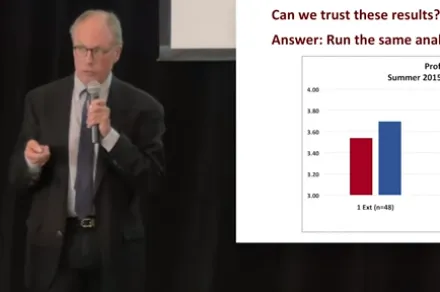
    At Denver Law, we are following the wisdom that counsels conducting assessment in small and discrete pieces. We will, each year, focus on parts of our JD program and assess learning in each using direct (student work product) and/or indirect (student self-reports) data. An example of the latter is our “Externship Program Professional Identity Formation Project.” At the start and upon completion of doing an Externship, Denver Law students rate themselves on ten items associated with professional identity and identity formation. From these responses, we compute a “Prof ID Formation Index” for each student, and we compare these measures before and after the Externship.

    1