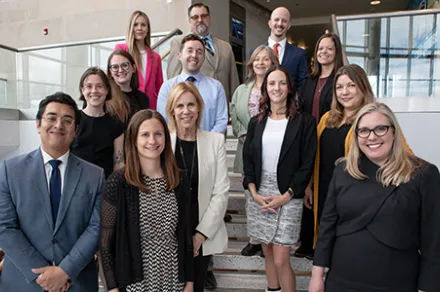
For states looking to implement or improve an allied legal professional program, IAALS' new report provides best practices regarding considerations like titles, practice areas, roles and responsibilities, and attorney supervision.
Each state with an allied legal professional program has its own unique qualifications to become licensed, but one thing all programs share is that the requirements are robust. Data shows ALPs competently handle legal tasks and prioritize consumer protection, ultimately increasing access to justice.
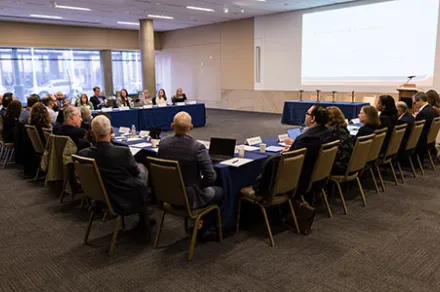
IAALS has published a new report summarizing discussions held at our groundbreaking convening and proposing next steps for regulatory innovation. It serves as a call to action for exploring and implementing innovative ways of delivering legal services nationwide.
The Colorado Supreme Court recently released guidelines permitting virtual participation in trial court proceedings. While crucial, this is only the initial stride in securing a transformative change for the court, their users, and society.
IAALS’ JPE 2.0 project is investigating and responding to concerns about judicial performance evaluation—with a goal of renewing JPE as a valued and trusted process going forward. A foundational white paper from IAALS serves as a primer for these important developments.
We are thrilled to welcome two new members to the IAALS team—Amy Livingston as director of development and Danielle Kalil as director of civil justice and the judiciary.
The Supreme Court’s recent affirmative action ruling will undoubtedly impact law school admissions and legal hiring. Now, more than ever, efforts to improve equity and inclusion are crucial for creating a more diverse legal profession.
The largest regulator of solicitors and law firms in England and Wales recently published a report examining the potential of unbundled legal services to improve access to justice, citing benefits to lawyers and their clients.
The demand for affordable and accessible legal services is resoundingly clear. As allied legal professional programs gain momentum, they are undeniably reshaping the legal profession—even in the face of resistance from some attorneys.
Divorce is complex and emotionally challenging, with state-specific waiting periods exacerbating delays. Simplifying the process and prioritizing individual agency and safety are crucial for a more equitable family law system.
Legal Aid of North Carolina is set to launch Innovation Lab, which aims to improve access to justice through technology integration, data collection, and collaboration. The Lab reflects a broader movement towards transformative approaches in the legal sector that emphasize evidence-based innovation and improved service delivery.
The legal community has varying opinions on regulatory reform, with some supporting, some opposing, and many unaware. As people explore this topic, they often encounter several arguments against reform—countered here with data and insights from other industries.
IAALS has released a report that includes multiple research-informed recommendations to help standardize a new tier of legal professionals across states, with the goal of increasing the options for accessible and affordable legal help for the public.
In April, the Colorado Access to Justice Commission released a strategic vision report, which outlines its two-year plan to advance access to justice throughout the state.
IAALS' new report analyzes the evolving role of courts in resolving cases and the factors impacting future filings, providing courts with the necessary data for planning, policymaking, and reform efforts.
This year, the American Bar Association is celebrating Law Day with the theme “Cornerstones of Democracy: Civics, Civility, and Collaboration.” These sentiments are at the heart of IAALS—what we do, how we do it, and why this work is so critical.
Last week, IAALS gathered with partners and friends for our 15th Annual Rebuilding Justice Award Dinner, celebrating the year’s awardees and recognizing our collective efforts to build a more inclusive justice system.
IAALS’ Lawyers Council is a new national group of law firms and businesses, whose members engage in IAALS’ process while also providing insight into their experiences in the justice system to inform our work.
A new report from the NCSC and IAALS highlights how enforcing court rules that require expedited actions can improve fairness, cost, and efficiency in the civil justice system while also relieving case backlogs exacerbated by the pandemic.
The Colorado Supreme Court has approved a program to license a new tier of legal service providers, who will be able to practice in certain types of family law matters such as divorce, custody, and protection orders.