News & Updates

List of news articles

Showing 681 - 700 out of 2118 results

  • Ethics Opinions Help Increase Unbundled Legal Services and Access to Justice

    As the number of self-represented litigants (or pro se litigants) continue to rise, the legal profession continues to explore alternative means of providing services beyond the traditional lawyer-client relationship. Because many litigants choose to forgo representation due to the cost of hiring an attorney, unbundled legal services are gaining more traction as a way to reduce costs while still providing valuable counsel for clients.

    1
  • Expert Opinion

    Ideas for Impact from IAALS’ Fourth Civil Justice Reform Summit

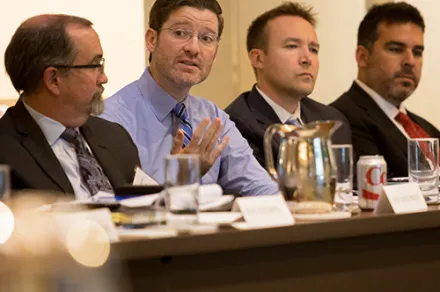
    At IAALS’ Fourth Civil Justice Reform Summit, we brought together stakeholders to brainstorm a vision for the courts of tomorrow and steps to get there. Today we release the report from that summit, Creating the Just, Speedy, and Inexpensive Courts of Tomorrow: Ideas for Impact from IAALS’ Fourth Civil Justice Reform Summit.

    1
  • 10th Anniversary

    Ten Years of IAALS: Building Foundations for Better Law Student Outcomes

    Figuring out how to educate law students to meet the needs of modern law practice is vitally important given shrinking job markets and changing demands on lawyers. IAALS has accepted that challenge with its Educating Tomorrow’s Lawyers initiative, which focuses on preparing new lawyers for successful participation in the legal profession. Law schools have traditionally focused on applicants’ LSAT scores and grade point averages to determine admissions to law schools. This produces a student body designed to perform well on standardized tests and in college-type settings. 

    1
  • New Videos Provide Training on Procedural Fairness for Judges and Court Staff

    Procedural fairness continues to be an area of great importance in the landscape of efforts to improve civil justice. The National Center for State Courts (NCSC) recently produced four informative training videos that explore how procedural-fairness principles can be applied in difficult situations often encountered in the courtroom and the clerk’s office.

    1
  • Expert Opinion

    A Call to Action in Our State Courts: Achieving Justice for All

    Over the last three years, I have had the privilege of chairing the Conference of Chief Justices’ Civil Justice Improvements Committee, whose recommendations were adopted last week by the Conference of Chief Justices and released today. The goal of this effort was to provide specific recommendations for how Chief Justices and Court Administrators in states across the country can address cost and delay in their state civil justice systems.

    1
  • In Ireland, a Proposal to Decrease the Waiting Period for Divorce

    “It is no secret that high-conflict litigation, particularly over a protracted period of time, only serves to increase hostility between a couple,” said Josepha Madigan, a member of the Irish Parliament who is advocating for a decrease in the time it takes to get divorced in the country. Current law requires married couples in Ireland to separate for four years before applying for divorce; the change would cut that time in half and allow for application after only two years.

    1
  • Guest Blog

    Revolutionizing Access to Justice for Litigants Without Lawyers

    As a pro se (or self-represented) litigant, imagine being faced with an overwhelming system of protocol, etiquette, deadlines, rules, and legalese. You are expected to navigate this foreign world to keep everything you care about from breaking as it spins to the ground. This system is one that takes attorneys years to understand.

    1
  • Press Release

    Foundations for Practice: IAALS Asks What Makes a New Lawyer Successful

    Today, aspiring lawyers across the country will sit for a bar examination that is intended to test their preparation for practice and will determine whether they will join the ranks of the legal profession this fall. While the bar examination has long been the measurement of what law graduates need in order to enter the profession, the profession and legal employers have nonetheless questioned its efficacy and the efficacy of legal education as a whole in actually preparing new lawyers. Many believe that American law schools are graduating lawyers unprepared to meet the demands of modern practice. Yet knowing what new lawyers need to succeed, and how they can acquire it effectively, was elusive until now.

    1
  • Maryland's Family Divisions Seen as Model for National Court Improvement

    In Maryland, the creation of special family divisions in the state’s five largest jurisdictions has transformed the way courts handle family law cases. A recent article in the National Center for State Courts’ 2016 Trends in State Courts explains how the creation of these special family divisions can provide a model for improving the way such cases are treated across the country.

    1
  • Help Wanted: An Update on Washington's Limited License Legal Technician Program

    Last summer, the Washington State Bar Association held its first round of exams in a new Limited License Legal Technician program (LLLT) aimed at bridging the access to justice gap by allowing non-lawyers to provide legal advice and assistance in limited areas, like domestic relations/family law. Now, a recent article provides an update how the LLLT program is progressing in the state.

    1
  • ETL Fellow John Lande Discusses the Future of Legal Education

    In a recent article, Educating Tomorrow’s Lawyers Fellow John Lande breaks down the results of a creative session held at the American Bar Association’s Section on Dispute Resolution Conference earlier this year. The session (and article) borrows its message from hockey great Wayne Gretzky, who said he always tried to skate “where the puck is going to be, not where it has been.”

    1
  • Self-Represented Litigants in Canada Find Less Success in Court According to New Data

    The National Self-Represented Litigants Project (NSRLP) recently released Canadian data on case outcomes for self-represented litigants (SRLs). These new figures come shortly after NSRLP published research showing that in cases where a self-represented litigant faces a motion for summary judgment brought by a represented party, 95% of SRLs will have their cases dismissed. 

    1
  • 10th Anniversary

    Ten Years of IAALS: Bridging the Gap Between Expectations and Legal System Performance

    We live in a time of cynicism and dissatisfaction with government—a dissatisfaction that includes the judicial branch. Gallup surveys of satisfaction with the way the nation is being governed have been stuck for the past few years at levels not seen since the days of President Richard Nixon and Watergate. Approval of the United States Supreme Court, which historically stayed safely in positive territory, has been close to 50-50 in recent years—and was negative (50% disapproving, 45% approving) at the start of the Court’s term last October.

    1
  • Everyone Has a Role to Play in Improving Legal Education

    As law schools across the country strive to produce lawyers who can hit the ground running—and as we gear up to launch our Foundations for Practice findings—Alli Gerkman, Director of Educating Tomorrow’s Lawyers, has been hitting the road around the country to explain how legal educators and employers can work together to shape the future of legal education.

    1