This month, The Pew Charitable Trusts released a new report that looks at trends in debt collection lawsuits in the United States and suggests steps that courts can take to modernize our state civil justice system and ensure access to justice. The economic impacts of the pandemic make these recommendations all the more critical and timely.
Last year, IAALS surveyed members of the American Board of Trial Advocates about their trust and confidence in the legal system and factors that influence their perspectives. A substantial majority of respondents reported high levels of confidence in both the state and federal court systems, but others gave us reasons for their declining confidence.
IAALS has launched a new project to help courts more quickly resolve the anticipated wave of business interruption insurance cases stemming from COVID-19-related closures and losses. The project will develop pattern discovery protocols specific to these cases, in an effort to reduce conflict and cost and to help both businesses and insurers alike reach a quick resolution.
Earlier this year, the National Center for State Courts published a set of recommendations for the redesign of the Marion Superior Court in Indianapolis, Indiana. Many of the suggestions stem from the Family Justice Initiative—supported by IAALS and the NCSC—and its Principles for Family Justice Reform.
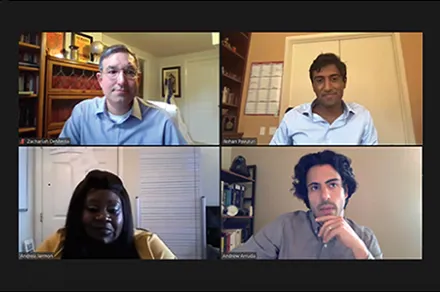
In April, the Association of Family and Conciliation Courts hosted a webinar focused on the Intersection of Technology, Domestic Violence, and Family Courts during COVID-19, and shared how tools we use on a daily basis can become lethal weapons when intimate partner violence is involved.
On August 9, 2020, friends, family, and fans of Alli Gerkman will gather virtually for Alli’s Rally: a fun, free, casual self-supported bike ride to celebrate Alli’s love for riding, her infectious laughter, and her extraordinary legacy.
In mid-April, the Louisiana Supreme Court announced changes to its rules to increase public access to judicial discipline proceedings. With these changes, Louisiana joins the growing tide of states that are embracing transparency—a key component of IAALS’ recommendations for judicial discipline systems.
In February, IAALS Manager Zack DeMeola joined the Law 2030 podcast of the University of Pennsylvania Law School’s Future of the Profession Initiative to talk about learning outcomes in law schools, predictions for the legal profession’s future, and how it all ties together with IAALS’ landmark Foundations for Practice project.
Law Day 2020 celebrates the centennial of the transformative amendment that gave women the right to vote. As we recognize this moment in our country's history, we also remember that the 19th Amendment has not translated to broader gender equality—and that our justice system, too, is not immune to claims of systemic inequality and bias.
This year, the ABA marks Law Day 2020 with the theme of “Your Voice, Your Vote, Our Democracy,” a celebration of the centennial of the passage of the 19th Amendment to the U.S. Constitution. We look to the women's suffrage movement for inspiration and to remind us that creating impact and change takes time.
In a recent article, IAALS Board of Advisors Member Jeremy Fogel challenges federal courts to use the data and information gathered through COVID-19-related emergency measures to evaluate and implement more modern court processes going forward. The federal courts’ remote technology response is unprecedented in its history, and they have a unique opportunity to seize on this change.
In this unprecedented time, IAALS continues in its work to ensure everyone who needs it has access to justice we can believe in. Our mission is critical, now more than ever—and we rely on a tremendous group of partners who help guide our work. We are thrilled to announce three new advisors: James J. Sandman, Kathryn A. Reilly, and Joey Orduña Hastings.
IAALS and the NCSC have finalized a three-year project with the release of their new report highlighting the experiences of four states—Idaho, Maine, Missouri, and Texas—as they worked to implement change in their courts. The recommendations can provide critical support to courts facing unprecedented need for change during the COVID-19 pandemic.
The COVID-19 pandemic poses unique challenges to lawyers and law students alike. For many students enrolled in live-client clinics, the challenges of meeting their clients' needs in a transitional environment are particularly demanding. Yet these law students in clinical programs have a unique opportunity to rise to the occasion.
Courts, judges, and lawyers have demonstrated a remarkable ability to adapt to a remote and technology-driven version of our justice system in response to the COVID-19 pandemic. These changes have fundamentally altered the way the system operates and call for a renewed commitment to civility and collegiality across the legal profession.
On April 10, the State Justice Institute hosted a webinar to launch its new Funding Toolkit for State Courts and Justice System Partners. The toolkit is designed to support courts and their partners as they pursue federal and philanthropic funding opportunities, and includes resources that cover the entire grant-seeking writing and management process.
In 2018, the NCBE created its Testing Task Force to conduct a three-year project that, in part, examines whether the bar exam is a valid measure of minimum competence to practice law. Last month, NCBE released a report detailing the findings of Phase 2, a national practice analysis, which will provide a foundation of data for bar exam reform.
The Advisory Committee on Civil Rules met virtually on April 1 and covered a number of different updates and discussion topics, including proposed amendments to Rule 30(b)(6). And, instead of the usual legislative update, Judge Bates provided an update on recent pandemic-related events related to the Committee.
On April 7, the ABA Board of Governors approved a resolution urging state licensing authorities to immediately adopt emergency rules that would authorize recent law school graduates to practice law without passing a bar exam, in light of the COVID-19 pandemic.
New Mexico is one of the latest states to look to regulatory innovation to increase access to legal services. On January 24, the state supreme court approved a number of recommendations, including enlisting nonlawyer court navigators to assist self-represented litigants in navigating the system.