News & Updates

List of news articles

Showing 121 - 140 out of 2118 results

  • 10th Anniversary

    Ten Years of IAALS: Spearheading Progress and Promise for a Better System

    I spent half my legal career as a civil trial lawyer in New Hampshire trying all manner of cases in state and federal court and sometimes trying or preparing to try cases in other states and jurisdictions. I learned from some great lawyers and mentors over those years. They viewed a jury trial not as a failure of the system but as an integral part of American justice. They tried many of their cases with four or five depositions, twenty key exhibits, an expert or two, and a theory of the case. Justice was almost always served. The lawyers I admired understood the probing value of focused, incisive cross examination, the transformative power of a witness's solemn oath, the value of the courtroom's sterile unfamiliarity in a search for the truth, and the capacity and integrity of juries to render fair verdicts. They viewed trial lawyering as a craft with a noble purpose and never viewed discovery as an end it itself.

    1
  • Poll Reveals New Jersey Voters in Favor of Judges Paying more for Benefits

    According to a recent poll, 70 percent of voters favor a proposed constitutional amendment that gives the legislature the authority to require that judges contribute more toward their pensions and benefits. Earlier this year, the state supreme court ruled that judges were exempt from a new law requiring public employees to pay more because it effectively reduced judges’ salaries in violation of the constitution.

  • 10th Anniversary

    Ten Years of IAALS: Collaboration to Drive the Future of Legal Education

    Deans of law schools throughout the nation are faced with unprecedented challenges in legal education: significant restructuring in the legal employment market, high student debt loads, dramatic declines in applicants for admission, rapid technological advances, students who learn in new ways, shifting accreditation standards, national ranking systems, and concerns from the bench and bar about the preparedness of new lawyers. Against this background, it is so critical that deans have a forum to interact with each other, practitioners, judges, a variety of legal employers, and the many parties interested in and committed to the future of legal education.

    1
  • Constitution Day

    The Gift of Judicial Independence

    The Framers of the Constitution knew a few important things about people in general. People want power. They seek to impose their will on others. They make mistakes. And they think they know more than they actually know. The Framers were introspective enough to see that these pervasive human shortcomings would be found in the public officials about to run our new government. The Framers, therefore, took systematic action to alleviate the impact of power-seeking, mistake-making, all-knowing officials who would fill the three branches.

    1
  • Access to Legal Services for Low Income People on President’s List of Cuts

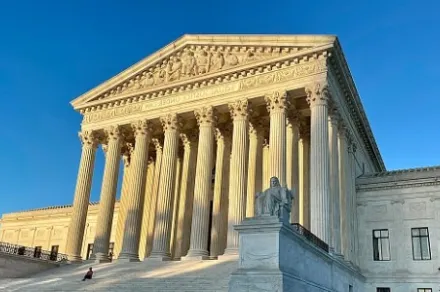
    On the front of the United States Supreme Court building in Washington, D.C., is the proclamation “Equal Justice Under Law.” However, according to our Cases Without Counsel study, in some jurisdictions nearly 80 percent of people with a court case end up representing themselves. For many, not being able to afford a lawyer is the main reason for the wide justice gap.

  • Stanching the Cash Flow

    The authors suggest that, though the Supreme Court of the United States has in recent years struck down campaign finance laws, it may be willing to tolerate limits on spending in judicial elections. Click here to read the article.

  • Jurors’ Public Social Media Profiles Are Fair Game for Trial Research

    In a time when nearly everyone has an online presence, more and more jurisdictions are having to navigate the extent to which trial lawyers can use a juror's social media to inform jury selection. In 2014, the American Bar Association's Standing Committee on Ethics and Professional Responsibility released Formal Opinion 466 on this topic. The Committee said that lawyers can review a juror or potential juror’s internet presence before or during a trial so long as they do not communicate with or request access from those jurors.

    1
  • Moore and Ten Other U.S. District Judge Nominees Move Forward

    Federal public defender Ray Moore was one of 11 nominees voted out of the Senate Judiciary Committee on February 14. If the timetable proceeds as it has with other nominees, the full Senate would vote on Moore’s nomination in April or May, though an informal Senate agreement regarding the time allowed for filibustering may speed up the overall confirmation process.

  • The Topsy Turvy World of North Carolina’s Courts

    This week, the North Carolina Senate created the new Senate Select Committee on Judicial Reform and Redistricting to consider various options for how the state selects judges. The committee’s formation comes after the North Carolina legislature took several steps recently to shake up the state's judicial system. Back in March, the legislature voted to override the governor’s veto of House Bill 100, which requires North Carolina Superior Court and District Court judges to identify their party affiliation on ballots. Proponents of the bill say voters want to know everything they can about judicial candidates when they vote. Opponents, like the governor, argue the bill politicizes the courts.

    1
  • Judicial Selection on the 2014 Ballot in Tennessee

    The house of representatives approved with a 78-14 vote a proposed constitutional amendment that would alter the process for selecting Tennessee’s appellate judges. The senate approved the measure 29-2 in February. The legislature also approved the proposal in 2012, so it will be on the ballot in 2014.

  • The Whole Lawyer: Consistent Across All Workplaces

    In July 2016, IAALS published Foundations for Practice: The Whole Lawyer and the Character Quotient, which shared findings from a survey that asked more than 24,000 lawyers what new lawyers need as they enter the profession. In the survey, we also collected from respondents ten demographic and practice-specific characteristics. We thought we might observe interesting, informative, and actionable differences across these demographics and characteristics. However, as we conducted analysis of the survey data for our reports, it became clear that our expectation was misplaced.

    1