


The O'Connor Judicial Selection Plan
Project Status: Advisor to state judicial selection leaders

A better way to select our nation's judges
IAALS and U.S. Supreme Court Justice Sandra Day O’Connor (Ret.) identified a model for choosing, evaluating, and retaining judges that balances the need for fair and impartial courts with the need for public accountability and transparency.
The O'Connor Judicial Selection Plan consists of four elements:
-
1
Judicial nominating commission
-
2
Gubernatorial appointment
-
3
Judicial performance evaluation
-
4
Retention elections
IAALS offers research-based recommendations for structuring each stage of the process to encourage highly qualified individuals to apply for judgeships, assure that the best judicial candidates are selected and retained, and engender support for the judiciary from the other two branches of government.

We at IAALS are among the many saddened by the passing of U.S. Supreme Court Justice Sandra Day O’Connor. We are honored that Justice O’Connor chose to partner with us to continue her work on judicial selection through IAALS, and we strive to carry on her legacy. Read our full tribute as well as reflections from Rebecca Love Kourlis.
Justice O'Connor & IAALS
When Justice Sandra Day O’Connor retired from the U.S. Supreme Court in 2006, she committed herself to two things she cares passionately about: judicial independence and civics education. She began working on judicial independence at Georgetown Law School through the “Sandra Day O’Connor Project on the State of the Judiciary,” a series of conferences co-sponsored by the Aspen Institute in 2006 through 2009.
Through these conferences, various themes and conclusions emerged. With respect to independence of the judiciary, the conference proceedings reflected that fairness and impartiality may be at risk in state court systems, particularly with reference to the selection methods for those state court judges. A commission-based appointment and retention election system is far preferable to contested elections, because it protects fair and impartial courts, keeps politics out of the process, and lets voters hold judges accountable for their performance on the bench.
As her project at Georgetown Law School neared conclusion in 2010, Justice O’Connor wanted to take the next step and begin fostering change directly at the state level. On December 8, 2009, she launched the Quality Judges Initiative at IAALS. We are honored that Justice O’Connor chose to partner with us to continue her work on judicial selection through IAALS.
In recent years, I have been distressed to see persistent efforts in some states to politicize the bench and the role of our judges. This Plan is a step toward developing systems that prioritize the qualifications and impartiality of judges, while still building in tools for accountability through an informed election process. Our recommendations here can help states set a course toward improving and refining their processes, and, ultimately, strengthening their judiciary. We all must seek to achieve those goals, because the courts are the bulwark of our democracy and we can ill afford to see them undermined.
— Justice Sandra Day O'Connor
United States Supreme Court
General Information about Judicial Selection
Judges in the United States are selected through a variety of methods, from popular elections to appointment by chief executives, legislatures, or other judges. Some of these methods are more effective than others in assuring public confidence in the integrity and quality of our courts.
Through legal and empirical analysis and recommendations, thought leadership, and substantive support, IAALS works to identify and promote models for choosing state and federal judges that emphasize qualifications and experience, limit political considerations and special interest influence, and provide transparency.
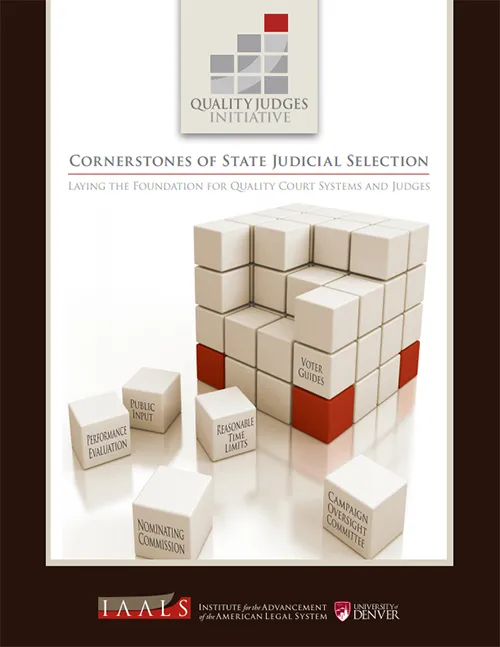
In addition to IAALS' O'Connor Judicial Selection Plan, we offer these other resources regarding judicial selection:


Project Team


O'Connor Advisory Committee (2009-2020)






Connect & Get Involved
Our work is only possible through purposeful listening and collaboration with people across the country. Everyone, from legal system stakeholders to members of the public, plays a critical role in our innovations. Together, we jumpstart the groundbreaking and achievable solutions that will clear a path to justice for everyone.