News & Updates

List of news articles

Showing 101 - 120 out of 488 results for Civil justice reform

  • Press Release

    New Pandemic Protocols for Litigation Will Help Struggling Businesses and Their Insurers

    IAALS has launched a new project to help courts more quickly resolve the anticipated wave of business interruption insurance cases stemming from COVID-19-related closures and losses. The project will develop pattern discovery protocols specific to these cases, in an effort to reduce conflict and cost and to help both businesses and insurers alike reach a quick resolution.

    1
  • To the Federal Courts: Don’t Abandon Current Emergency Measures on Virtual Technology—Evaluate Them Instead

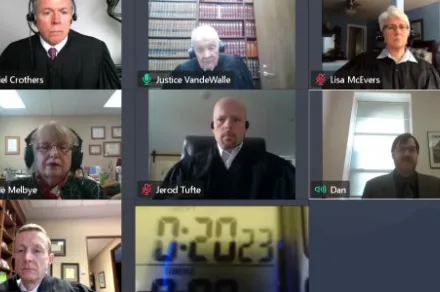
    In a recent article, IAALS Board of Advisors Member Jeremy Fogel challenges federal courts to use the data and information gathered through COVID-19-related emergency measures to evaluate and implement more modern court processes going forward. The federal courts’ remote technology response is unprecedented in its history, and they have a unique opportunity to seize on this change.

    1
  • Expert Opinion

    Civility and Cooperation in the Time of Coronavirus

    Courts, judges, and lawyers have demonstrated a remarkable ability to adapt to a remote and technology-driven version of our justice system in response to the COVID-19 pandemic. These changes have fundamentally altered the way the system operates and call for a renewed commitment to civility and collegiality across the legal profession.

    1
  • Federal Rules Developments Continue During Pandemic

    The Advisory Committee on Civil Rules met virtually on April 1 and covered a number of different updates and discussion topics, including proposed amendments to Rule 30(b)(6). And, instead of the usual legislative update, Judge Bates provided an update on recent pandemic-related events related to the Committee. 

    1
  • New Mexico to Implement Court Navigators Pilot Program

    New Mexico is one of the latest states to look to regulatory innovation to increase access to legal services. On January 24, the state supreme court approved a number of recommendations, including enlisting nonlawyer court navigators to assist self-represented litigants in navigating the system. 

    1
  • Justice, Plain and Simple: Proposals for the Legal Community

    In January, the Association of Family and Conciliation Courts' Family Court Review published an article highlighting the key takeaways, proposals, and results from last spring's Plain and Simple: Making the Legal System Accessible to All conference. The conference was directed at the immense need for plain language and simplification reform efforts, and was co-sponsored by IAALS.

    1
  • Expert Opinion

    Rule Makers vs. Risk Takers

    Imagine a legal sector neatly divided into two groups: the Rule Makers and the Risk Takers. With evidence piling up that the legal market is not working for ordinary citizens, the Rule Makers come together to evaluate possible changes. After the new rules are enacted, the burden shifts to the Risk Takers to build out workable solutions.

    1
  • State and Federal Courts Prepare for Coronavirus

    ​As the number of cases of COVID-19 in the United States rises, both state and federal courts are preparing for how they will (or won’t) continue operating should more people quarantine and many other functions of public life temporarily shut down.

    1
  • Annual Report

    Justice We Can Believe In: Read the 2019 IAALS Annual Report

    People look to our legal system for help in matters that affect their rights, their families, their businesses, and the most intimate aspects of their lives. But, for too long and for too many, the courthouse doors seem closed—and justice out of reach. IAALS is changing that. We are proud to present you with our 2019 Annual Report, which highlights our work and accomplishments toward ensuring that everyone has access to justice we can believe in.

    1
  • Text and Email Notifications Keep Court Users Up to Date

    In today’s increasingly busy and connected world, electronic notifications play a significant role in keeping us up to date. One would expect that due to the serious nature of court proceedings that the courts would be up-to-date with messaging or other communication capabilities, but unfortunately that is not the case. However, many courts are beginning to change that reality.

    1
  • Guest Blog

    Michigan Revises Civil Discovery Court Rules

    On January 1, 2020, Michigan implemented its first major overhaul of its civil discovery rules in nearly forty years. A State Bar Association Committee was formed in 2017 to evaluate the current rules and recommend amendments that could help increase access to the courts; as a foundation to its work, the Committee looked to the 2015 federal civil rule amendments, the discovery innovations in other states, IAALS’ research and recommendations, and the Conference of Chief Justices’ national recommendations for state reform.

    1