News & Updates

List of news articles

Showing 41 - 60 out of 79 results for Research

  • Expert Opinion

    Process Matters in Legal Regulation Reform

    We’re researchers who study legal services regulation and access to the civil justice system. We’ve been thrilled to watch groundbreaking announcements from the West ignite a wide-ranging national debate about how best to regulate legal training, services, and businesses—and we’ve been paying special attention to the role people who are not lawyers are playing in the process of legal re-regulation.

    light wooden blocks with people painted on them, connected by lines, on light blue background
  • Expert Opinion

    The IAALS Effect on Hiring at Wheeler Trigg O’Donnell

    At Wheeler Trigg O’Donnell, we’ve been fortunate to have a front-row seat to the outcomes and transformation that IAALS has achieved through Foundations for Practice. We collaborated with IAALS to survey our partners on the characteristics that they viewed as most essential for new associates to be successful at WTO, and the outcomes for retention and diversity have been exciting and encouraging.

    lobby with tile floors, armchairs, end tables, reception desk, and floor-to-ceiling windows
  • Making the Case for More Civil Justice Data

    The Georgetown Civil Justice Data Commons recently made the case for “Why We Need Civil Justice Data,” laying out how those living in or near poverty also face a multitude of issues related to housing, finances, health, and overall well-being. Each of these areas can easily cross over into civil legal issues—and oftentimes, they do.

    scales of justice made of code
  • State Justices Stress Need for Courts to Lead the Way on Regulatory Reform

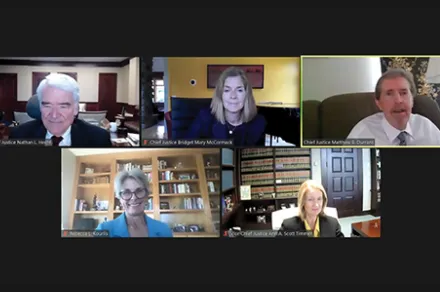
    This month, IAALS and its partners kicked off the Redesigning Legal Speaker Series with a panel exploring how judicial leadership can play a critical role in expanding access to legal services and access to justice. The panelists discussed the status of regulatory innovation, how courts and others are seeking to address the problems, and why state supreme courts and the organized bar must start forging solutions now.

    five people on Zoom call
  • New Publications

    IAALS Releases New Tools to Cut through Bias in Legal Hiring and Improve Legal Education Outcomes

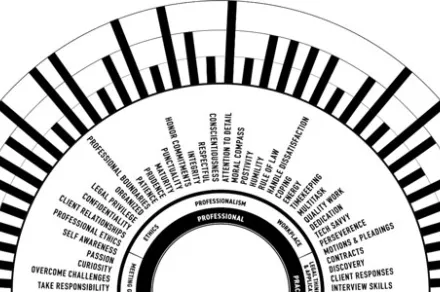
    IAALS has released two new guides that detail innovative ways for legal educators and legal employers to implement data-driven, outcomes-based standards to train and hire better lawyers. The guides are the first in IAALS' new suite of Foundations tools to create alignment between law schools and legal employers, and to address structural problems within the legal profession.

    1
  • Annual Report

    Equity, Access & Justice: Read the 2020 IAALS Annual Report

    The last twelve months have been an unforgettable crucible. At IAALS, we have taken a hard look at our work and what it will take to build a better legal system for everyone. Our 2020 Annual Report illustrates our ability to foster the change we need—and our capacity to do even more.

    1
  • Press Release

    IAALS Announces 2021 Rebuilding Justice Award Recipients

    IAALS has announced that Utah Supreme Court Justice Deno Himonas and Utah attorney John Lund are the recipients of the organization’s 2021 Rebuilding Justice Award. IAALS is proud to recognize the achievements of Himonas and Lund for their efforts in founding Utah’s Office of Legal Services Innovation.

    1
  • Expert Opinion

    Program Evaluation Is Critical in Assessing Court Technology

    Throughout the past ten months, our justice system has made giant strides in its use of technology, including video- and tele-conferencing, e-filing, remote jury trials, and online dispute resolution. The question now faced by many courts is: are these digital processes working like they’re supposed to?

    1
  • US Justice Needs Project Benefits From Collaboration with Our Partners

    Last week, IAALS and our project partner HiiL cohosted a series of virtual Justice Data Lab meetings with our US Justice Needs Advisory Committee and a few additional partners. In August launched the individual survey of legal problems, receiving responses from 10,000 individuals from across the United States, and we are now analyzing the data.

    1
  • Guest Blog

    Measuring Justice Needs and Delivery in a Pandemic

    In June of this year, HiiL surveyed thought leaders in the justice sector about what it would mean to deliver justice during the COVID-19 crisis. The goal was to collect real-time data about justice needs and innovative responses to the pandemic, including the kinds of problems expected to increase and the ways justice institutions in various countries were already responding to them. 

    1
  • Expert Opinion

    Research and Data in this Season of Change

    After COVID-19 and the social unrest around racial equity, our world will never be the same. We have a duty to ensure that we learn from this season of change and to use the knowledge we have gained to create a better world. To do so, we must be guided by data and evidence—and we must improve our data and research practices.

    1
  • Expert Opinion

    IAALS Survey Explores Attorneys' Trust and Confidence in the Legal System

    Last year, IAALS surveyed members of the American Board of Trial Advocates about their trust and confidence in the legal system and factors that influence their perspectives. A substantial majority of respondents reported high levels of confidence in both the state and federal court systems, but others gave us reasons for their declining confidence.
    1
  • Annual Report

    Justice We Can Believe In: Read the 2019 IAALS Annual Report

    People look to our legal system for help in matters that affect their rights, their families, their businesses, and the most intimate aspects of their lives. But, for too long and for too many, the courthouse doors seem closed—and justice out of reach. IAALS is changing that. We are proud to present you with our 2019 Annual Report, which highlights our work and accomplishments toward ensuring that everyone has access to justice we can believe in.

    1